★ Back to Bands
★ Ranked Songs · Guns N' Roses · Hard Rock · Los Angeles

Guns N' Roses Best Songs Ranked — The Definitive Guide

Guns N' Roses were the most dangerous band in the world — five degenerates from Los Angeles who arrived in 1987 with an album that felt genuinely threatening in a way no mainstream rock had managed in years. From Appetite for Destruction to the Use Your Illusion epics and the Not in This Lifetime reunion, this guide ranks the 10 best GNR songs, explains their meanings, and maps everything new fans need to know.

Guns N' Roses performing live — Axl Rose and Slash on stage
★ JUMP TO SONG

What Makes a Great Guns N' Roses Song?

A great Guns N' Roses song captures a specific quality that very few rock bands have achieved at the highest level: genuine danger made musically irresistible. The five people who made Appetite for Destruction were not performing danger — they were living it, and the music reflected that in ways that no amount of production craft alone could achieve. The aggression, the excess, the barely-controlled chaos of the early GNR material comes from somewhere real, which is why it has retained its power across nearly forty years.

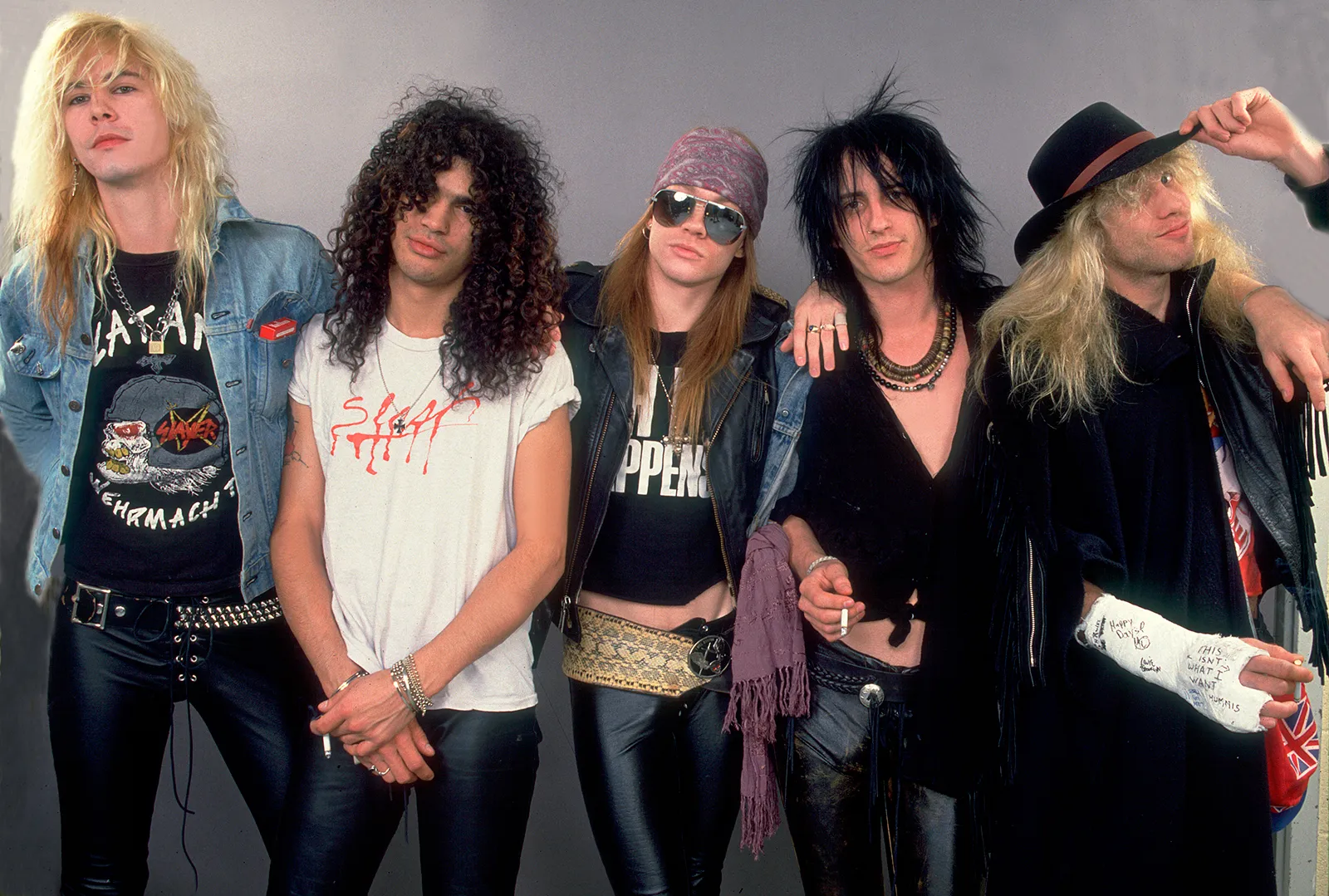
Guns N' Roses formed in Los Angeles in 1985 — Axl Rose and Izzy Stradlin from Indiana, Slash from London, Duff McKagan from Seattle, Steven Adler from Ohio — a band of outsiders who assembled in LA and proceeded to tear the city apart with a combination of hard rock aggression and genuine street-level authenticity that the polished glam metal of the era entirely lacked. Appetite for Destruction (1987) became one of the best-selling rock albums of all time; the Use Your Illusion albums (1991) expanded the ambition dramatically; and the subsequent years of lineup changes, lawsuits, Chinese Democracy (2008) and the Not in This Lifetime reunion (2016) constitute one of the most dramatic band narratives in rock history.

This ranking acknowledges both eras — the raw Appetite material and the more ambitious Use Your Illusion epics — placing November Rain first as the artistic peak while honouring the early material's foundational importance.

Top 10 Guns N' Roses Songs Ranked

01

November Rain

Album: Use Your Illusion I · 1991
Use Your Illusion I

November Rain is Guns N' Roses' most ambitious and most fully realised piece of music — a nine-minute epic that encompasses power ballad, orchestral rock and one of the greatest guitar solos ever recorded, and that does all of this without losing the emotional urgency that makes the best GNR material feel urgent rather than merely impressive. The song was something Axl Rose had been developing for years before Use Your Illusion made its recording financially possible, and the patience of that development is audible in the result: every element is exactly where it needs to be.

Slash's two guitar solos — particularly the second, played at the church in the video — are the finest work of his career. The specific combination of melodic invention, emotional expression and technical control in those passages represents the peak of hard rock guitar playing in the 1990s, and the song's nine-minute runtime gives them the context they require. The orchestral arrangement, rather than softening the song, gives it a grandeur that makes the emotional weight of the lyric feel proportional.

The music video — a mini-film of extraordinary production scale, depicting a wedding, a rainstorm and a funeral — became one of the most watched videos in MTV history and gave the song a visual identity that remains inseparable from the music for many listeners.

Song Meaning

November Rain is about the fear that love will not last — the specific anxiety that what exists between two people is temporary and vulnerable to the passage of time. Axl Rose has described it as one of the most personally significant songs he has written. The song was partly inspired by a short story called "Without You" by Del James, which also provided the conceptual framework for the video. The rain of the title is both a literal symbol of sadness and a broader metaphor for the melancholy that accompanies love — the awareness that everything beautiful is also fragile.

Why #1: the most ambitious and most fully realised GNR song — nine minutes of orchestral hard rock with the greatest Slash guitar solo on record, and the clearest evidence of what the band could achieve at their most ambitious.
02

Welcome to the Jungle

Album: Appetite for Destruction · 1987
Appetite for Destruction

Welcome to the Jungle is the most immediately threatening song on Appetite for Destruction and the track that most fully announces what Guns N' Roses was — a band prepared to be genuinely dangerous in a rock landscape that had largely settled into comfortable polish. The opening guitar figure (da-da-da-da-da-da-da-da-da, and the street was waiting) is one of the great rock introductions: establishing tone, character and menace in a few bars before the song explodes into full force.

Axl Rose's vocal here is at its most rawly expressive — the specific quality of a voice that sounds genuinely uncontrolled while remaining completely in service of the song's emotional content. The snake-like hiss of "d'ya know where you are?" in the pre-chorus is one of the most memorable moments in hard rock singing of the decade, precisely because it sounds like a genuine threat rather than a performance of one.

Song Meaning

Welcome to the Jungle is about arriving in Los Angeles — the specific experience of a young person from somewhere smaller encountering the city's overwhelming combination of excess, danger, promise and exploitation. Rose has described writing it from his own experience of arriving in LA from Indiana. The "jungle" is Los Angeles itself: a place of predators and prey where the uninitiated are rapidly consumed. The song is simultaneously a warning and an invitation, which is the specific ambivalence that makes it more interesting than a simple cautionary tale.

Why #2: the most immediately threatening GNR song and the track that most directly announces what the band was — genuine danger made irresistible.
03

Paradise City

Album: Appetite for Destruction · 1987
Appetite for Destruction

Paradise City is the most collectively joyful Guns N' Roses song and the one most capable of producing the specific feeling of being part of a large crowd that is all singing the same words simultaneously. The "take me down to the paradise city / where the grass is green and the girls are pretty" has been sung by more people, in more stadiums, than almost any other hard rock lyric of the era — the simplicity of the imagery is its strength, and the longing it expresses (the desire to be somewhere better, somewhere free) is so universal that it transcends any biographical specificity.

The song also contains the finest Slash rhythm guitar work on Appetite — the opening riff's specific groove, the way the verse drives without becoming repetitive — and the tempo escalation into the final section, where the song moves from mid-tempo to furious, is one of the great dynamic moments in 1980s hard rock. The combination of the group chorus and the musical acceleration at the end of every live GNR performance remains one of rock's most reliably overwhelming collective experiences.

Why #3: the most collectively joyful GNR song — the chorus that has united more arenas than almost any other hard rock lyric, and the song most capable of producing the communal live rock experience at its most overwhelming.
04

Sweet Child O' Mine

Album: Appetite for Destruction · 1987
Appetite for Destruction

Sweet Child O' Mine is Guns N' Roses' most famous song to the widest possible audience and the one most likely to be a new listener's first encounter with the band. The opening guitar figure — developed by Slash as a finger exercise and retained when Rose wrote a lyric to it — is one of the most recognisable sounds in the history of rock guitar, and the combination of that riff with Rose's love-song lyric creates something entirely unlike the surrounding material on Appetite: gentle, warm, sincere.

The sincerity is the most surprising element for listeners who approach GNR through their reputation for excess and aggression. Sweet Child O' Mine is a straightforward love song with no irony and no qualification, written about a specific person (Erin Everly, Rose's then-girlfriend) and carrying the emotional weight of that specificity. The contrast between the song's warmth and the surrounding Appetite material is what makes the album as a whole more interesting than its reputation as a simple hard rock record.

Song Meaning

Sweet Child O' Mine was written by Axl Rose about Erin Everly, daughter of Don Everly of the Everly Brothers, his girlfriend at the time. The lyric captures the specific quality of a love that feels like refuge — the narrator's eyes, described as "a place I never stray," and the way looking at her eyes allows escape from present difficulties. Rose has described the song as nearly accidental — written quickly after Slash developed the guitar figure — and has spoken about how genuine the feeling behind it was. It became GNR's first and only US number one single.

Why #4: GNR's most famous song and their only US number one — placed fourth rather than first because the songs above it are more fully realised, which is a measure of the catalogue's depth rather than any failing in the song.
05

Civil War

Album: Use Your Illusion II · 1991
Use Your Illusion II

Civil War is the most politically serious and most compositionally ambitious piece on Use Your Illusion II — a seven-minute meditation on war, violence and humanity's seemingly inescapable tendency toward self-destruction, delivered with a conviction and a musical intelligence that the band's more purely hedonistic material does not attempt. The song opens with a sample from Cool Hand Luke before building through acoustic passages, electric sections and a chorus of devastating simplicity: "what's so civil about war anyway?"

Written during a period when the band were engaging more seriously with political and social subject matter (the Use Your Illusion albums were recorded with the Cold War ending and the Gulf War beginning), Civil War demonstrates that Axl Rose's lyrical ambitions extended well beyond the Los Angeles street-level realism of Appetite. The song was originally released as a charity single for Armenian earthquake relief, which gives it a contextual weight that its studio album position occasionally obscures.

Why #5: the most politically serious and most compositionally ambitious GNR song — where the band's reach toward something larger than their street-level origins is most successfully achieved.
06

Nightrain

Album: Appetite for Destruction · 1987
Appetite for Destruction

Nightrain is the most purely fun and most energetically relentless track on Appetite for Destruction — the song that most directly captures the specific quality of the early GNR live experience: the barely-controlled chaos, the physical momentum, the sense of people who are genuinely living the excess they are singing about. The riff drives without let-up from first bar to last, Slash's solo is among his most immediately satisfying, and Rose's vocal has a swagger and a self-satisfaction that suits the song's subject perfectly.

The song is named after Night Train wine — a cheap, high-alcohol fortified wine that was a staple of LA street life in the mid-1980s. The autobiographical content is cheerfully, unapologetically specific: the band really were drinking Night Train in the early days, and the song celebrates rather than apologises for that reality.

Why #6: the most purely energetic Appetite track and the one that most directly captures the early GNR live experience — real excess celebrated without apology.
07

Estranged

Album: Use Your Illusion II · 1991
Use Your Illusion II

Estranged is the most emotionally raw and most personal song in the GNR catalogue — a nearly ten-minute piece that closes Use Your Illusion II with an emotional directness and a musical ambition that constitutes the most fully realised artistic statement on the double album. The song is about the dissolution of a relationship — the specific feeling of estrangement from someone who has been the centre of your life — and the vulnerability of the lyric is more exposed than anything Rose had previously put on record.

The production includes orchestral elements, multiple tempo changes and two distinct Slash solos, building to a final section of overwhelming emotional force. The accompanying video — featuring Rose jumping from a tanker into the ocean, surrounded by dolphins — is one of the most cinematic GNR visual statements. For listeners who have exhausted the more famous material and want to understand the full depth of the GNR catalogue, this is where to go.

Why #7: the most emotionally exposed and most personally vulnerable GNR song — the full Use Your Illusion ambition applied to the most directly personal subject matter in the catalogue.
08

Mr. Brownstone

Album: Appetite for Destruction · 1987
Appetite for Destruction

Mr. Brownstone is the most insightful and most self-aware song on Appetite for Destruction — a track that addresses heroin addiction with a mixture of black humour and genuine dread that distinguishes it from both the romanticisation and the moralising that most rock music deploys on the same subject. The song was written about the band's own experience with the drug (Slash and Steven Adler were both addicted during this period), and the autobiographical specificity is what makes it feel honest rather than opportunistic.

The Izzy Stradlin rhythm guitar work throughout Mr. Brownstone is the finest example of his contribution to the GNR sound — the specific groove, the way the rhythm part drives the song with a momentum that the lead guitar supplements rather than defines. It is the track that most clearly demonstrates that GNR was a five-person band rather than Axl and Slash with accompanists.

Why #8: the most self-aware and most honest GNR song — addiction addressed with black humour and autobiographical specificity, the Izzy Stradlin contribution at its most essential.
09

Live and Let Die

Album: Use Your Illusion I · 1991
Use Your Illusion I

Live and Let Die is a cover of the Paul McCartney-penned James Bond theme from 1973 — and the GNR version is one of the most successful rock cover versions of a pop song in the genre's history. The original is already a dramatic piece of writing that moves through multiple contrasting sections, and the GNR arrangement harnesses that drama with a heaviness and an energy that the original's orchestral setting could not achieve. Axl Rose's vocal performance here is one of his most technically demanding on any GNR recording, and the sheer force of the heavy sections makes the song a live highlight.

It is a statement of musical range as much as anything else — the choice to cover McCartney rather than another hard rock act demonstrates the breadth of the band's influences and their confidence in their ability to recontextualise material from entirely different musical worlds.

Why #9: the most successful GNR cover — a dramatic Bond theme recontextualised with hard rock heaviness, demonstrating the band's musical range and confidence.
10

You Could Be Mine

Album: Use Your Illusion II · 1991 / Terminator 2 soundtrack
Use Your Illusion II

You Could Be Mine is the most immediate and most energetically direct track on the Use Your Illusion albums — the song that sounds most like Appetite for Destruction while demonstrating the increased production polish of the 1991 records. Its association with Terminator 2: Judgment Day (the Schwarzenegger-scanning-the-band video became one of the most memorable of the era) gave it a cultural reach beyond the GNR fanbase and made it one of the most recognised tracks of 1991.

The song's attitude — dismissive, swaggering, treating a romantic relationship with the same barely-engaged contempt as everything else — is early GNR at its most characteristic, and the performance has the physical momentum that the longer, more ambitious surrounding tracks occasionally sacrifice for compositional range. It is the Use Your Illusion track that most directly bridges the two eras of the band.

Why #10: the most direct and most energetically immediate Use Your Illusion track — the Terminator 2 tie-in that bridged the band's two eras and demonstrated their continued raw energy.

Best Guns N' Roses Songs for Beginners

New to Guns N' Roses? These six tracks introduce the different sides of the band — the danger, the love song, the anthem, the political epic and the orchestral ambition.

Sweet Child O' MineStart here — the most famous GNR song and the most accessible entry point, Slash's most recognised riff and Rose's most sincere love lyric.
Welcome to the JungleThe most immediately threatening track — where the genuine danger of early GNR is most directly present.
Paradise CityThe best collective experience — the chorus that has united more arenas than almost any other hard rock song.
NightrainThe most purely energetic Appetite track — the raw early GNR sound at maximum momentum.
November RainOnce the earlier material is familiar — the nine-minute epic that shows the full artistic ambition of what GNR could achieve.
Civil WarThe most politically serious track — for listeners who want to understand how far the band's reach extended beyond the street-level debut.

Axl Rose: The Voice and the Chaos

William Bruce Rose Jr. — known as Axl Rose — was born on 6 February 1962 in Lafayette, Indiana. He grew up in difficult circumstances, left Indiana for Los Angeles in the early 1980s, and assembled the band that would become Guns N' Roses from the various LA scene musicians he met there. He is one of the most technically gifted and most personally volatile vocalists in rock history — a four-octave range that extends from baritone to a stratospheric shriek, deployed in service of an emotional intensity that has never been fully replicated.

His personal history — abusive childhood, legal troubles, the breakdown of the original GNR lineup through his uncompromising behaviour, the fifteen-year recording process for Chinese Democracy (2008) — is one of the most dramatically turbulent in mainstream rock. He has been widely criticised for his treatment of bandmates and for his notorious habit of starting concerts hours late. He has also produced some of the most powerful and most personal vocal performances in hard rock history.

The Not in This Lifetime reunion with Slash and Duff McKagan in 2016 — after twenty years of public acrimony — was received with relief and genuine excitement by a fanbase that had spent two decades wondering if it would ever happen. The reunion tour became one of the highest-grossing in concert history.

Slash: The Guitar Icon

Saul Hudson — known universally as Slash — was born on 23 July 1965 in Hampstead, London, to a British father and an American mother. The family relocated to Los Angeles when he was eleven, and he began playing guitar as a teenager, developing rapidly into one of the finest blues-influenced rock guitarists of his generation. His visual identity — the top hat, the cigarette, the Les Paul Standard, the curly hair obscuring his face — became one of rock's most recognisable images.

His playing style draws heavily on the blues tradition (he has cited Eric Clapton, Robert Johnson and Jimi Hendrix as primary influences) while operating at the speed and aggression of hard rock. The combination produces a tone and a melodic sensibility that is entirely his own — instantly recognisable from a single note, which is the standard by which all rock guitarists should be measured. The opening of Sweet Child O' Mine, the solos in November Rain, the riff of Welcome to the Jungle: these are among the most immediately and most universally recognisable sounds in the history of the electric guitar.

Slash left GNR in 1996 following years of creative and personal tensions with Axl Rose. He formed Velvet Revolver with Duff McKagan and Scott Weiland and has released solo albums. His reunion with GNR in 2016 remains one of the most celebrated reconciliations in rock history.

Best Guns N' Roses Albums to Hear Next

1987
Appetite for Destruction

The essential starting album and one of the best-selling rock records of all time. Contains Welcome to the Jungle, Sweet Child O' Mine, Paradise City, Nightrain, Mr. Brownstone and My Michelle. The definitive GNR statement — raw, dangerous, perfectly sequenced.

1991
Use Your Illusion I

The ambitious first of the double album. Contains November Rain, Live and Let Die, Don't Cry, Right Next Door to Hell and Garden of Eden. More polished and more varied than Appetite — the first evidence of what GNR's expanded ambitions could produce.

1991
Use Your Illusion II

The essential companion to UYI I. Contains Civil War, You Could Be Mine, Estranged, Yesterdays and Locomotive. Heavier and more aggressive than the first volume while also containing some of the most ambitious material in the catalogue.

1988
G N' R Lies

The EP/mini-album that bridges the debut and the Use Your Illusion era. Contains Patience (the acoustic ballad that demonstrated Rose's melodic range) and the live tracks from the earlier EP. Essential for Patience alone.

Honourable Mentions

The GNR catalogue — particularly across the two Appetite and Use Your Illusion eras — contains many essential tracks below this top 10. Strong honourable mentions include:

  • Patience (G N' R Lies, 1988) — the acoustic ballad that first demonstrated Rose's melodic range and the band's ability to operate outside their comfort zone, and one of the most beloved GNR songs
  • Rocket Queen (Appetite for Destruction, 1987) — the most musically sophisticated Appetite track and the album's most dramatically effective closing statement
  • My Michelle (Appetite for Destruction, 1987) — one of the finest early GNR tracks, addressed to a real person (Michelle Young) with a specificity that is both affectionate and brutal
  • Don't Cry (Use Your Illusion I, 1991) — the most melodically direct Use Your Illusion ballad and the most immediately accessible track on the first volume
  • Locomotive (Use Your Illusion II, 1991) — the most rhythmically inventive GNR track and the best demonstration of the band's ability to build a complex arrangement across an extended runtime
  • Hard Skool (single, 2021) — the best post-reunion material, demonstrating that the reunited lineup still had something to contribute beyond nostalgia

Guns N' Roses Band History

Guns N' Roses formed in Los Angeles in 1985 from the merger of two existing bands — Hollywood Rose (Axl Rose and Izzy Stradlin) and L.A. Guns (Tracii Guns, Ole Beich and Rob Gardner). The immediate dissolution of the original non-Rose/Stradlin members and their replacement by Slash, Duff McKagan and Steven Adler produced the lineup that recorded Appetite for Destruction.

The path to the debut's release was difficult — the band lived on the streets for periods, survived on minimal money and struggled to secure label interest despite a strong local reputation. Geffen Records' eventual signing and the release of Appetite in 1987 produced one of the most spectacular commercial breakthroughs in rock history, albeit gradually: the album was not an immediate chart success, building through touring and radio play over more than a year to eventually sell in excess of 30 million copies worldwide.

The subsequent years were marked by addiction, internal conflict and the progressive replacement of original members. Steven Adler was replaced by Matt Sorum in 1990; Izzy Stradlin departed in 1991 and was replaced by Gilby Clarke. The Use Your Illusion albums and the accompanying world tour (1991–1993) were commercial triumphs accompanied by notorious incidents including the Montreal riot (1992). Slash departed in 1996; Duff McKagan in 1997. Rose continued under the GNR name with an entirely different lineup through a fifteen-year recording process that produced Chinese Democracy (2008).

The Not in This Lifetime reunion of Axl Rose, Slash and Duff McKagan in 2016 was received as one of the most significant events in rock reunion history. The subsequent tour became one of the highest-grossing concert tours ever. New material — Hard Skool and Absurd — was released in 2021.

Guns N' Roses Songs: FAQ

What is Guns N' Roses' best song?
November Rain is placed first in this ranking as the most ambitious and most fully realised GNR piece — nine minutes of orchestral hard rock with Slash's greatest guitar solo. Sweet Child O' Mine is the most famous and the essential entry point; Welcome to the Jungle is the most immediately dangerous.
What does November Rain mean?
About the fear that love will not last — the anxiety that what exists between two people is temporary and vulnerable to time. Rose has described it as one of his most personally significant songs. The rain is both a literal symbol of sadness and a broader metaphor for the melancholy that accompanies love.
What does Welcome to the Jungle mean?
About arriving in Los Angeles — a young person from somewhere smaller encountering the city's combination of excess, danger, promise and exploitation. Rose wrote it from his own experience of arriving from Indiana. The "jungle" is LA; the song is simultaneously a warning and an invitation.
What does Sweet Child O' Mine mean?
A love song written by Rose about Erin Everly — the specific quality of a love that feels like refuge. Rose has described writing it quickly, almost accidentally. It became GNR's only US number one single and the most famous Slash guitar figure in history.
Who is Slash?
Slash (Saul Hudson, born 1965, Hampstead, London) is GNR's lead guitarist and one of the most iconic rock guitarists in history. Known for his top hat, Les Paul guitar and blues-influenced playing style. His tone is instantly recognisable from a single note. Left GNR in 1996 and returned for the Not in This Lifetime reunion tour in 2016.
What is the best Guns N' Roses album to start with?
Appetite for Destruction (1987) is the best starting album — it contains Welcome to the Jungle, Sweet Child O' Mine, Paradise City and Nightrain and is one of the best-selling rock albums of all time. Use Your Illusion I and II are the essential second step.
Is Guns N' Roses still active?
Yes. GNR reformed with the original lineup of Axl Rose, Slash and Duff McKagan for the Not in This Lifetime tour in 2016 — one of the highest-grossing concert tours in history. They released Hard Skool and Absurd in 2021 and continue to tour internationally.
Where are Guns N' Roses from?
Guns N' Roses formed in Los Angeles, California in 1985. The individual members came from several locations — Axl Rose and Izzy Stradlin from Indiana, Slash from London (via LA), Duff McKagan from Seattle and Steven Adler from Ohio. Their identity is fundamentally Los Angeles, specifically the Sunset Strip rock scene of the mid-1980s.
What happened between Axl Rose and Slash?
Slash left GNR in 1996 after years of creative and personal tensions with Rose. The split was acrimonious and the two did not speak publicly for nearly two decades. Their reconciliation — leading to the Not in This Lifetime reunion tour in 2016 — was received as one of the most surprising and most welcome events in rock history.
What does Mr. Brownstone mean?
"Mr. Brownstone" is a slang term for heroin. The song addresses the band's own experience with addiction — Slash and Steven Adler were both dependent during this period — with black humour and autobiographical honesty. It is the most self-aware early GNR track and the one that most directly acknowledges the darker dimension of the excess the surrounding material celebrates.

Explore More Rock Guides