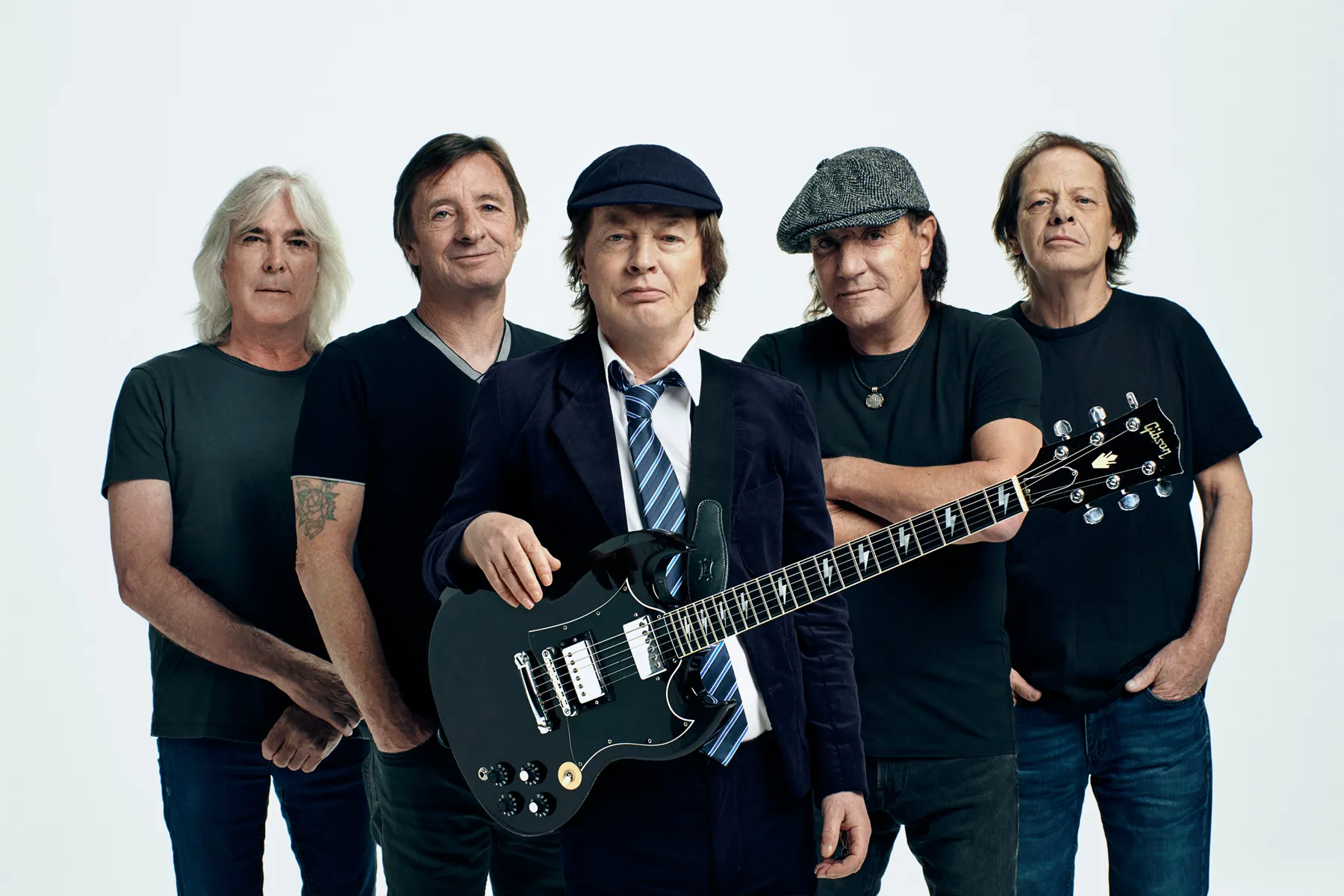
What Makes a Great AC/DC Song?
A great AC/DC song is built on a paradox of simplicity: everything
sounds easy to play and nothing sounds easy to copy. Angus Young's
guitar is technically straightforward — no sweep picking, no
extended techniques, no equipment that requires a manual — but the
feel is completely his own. Malcolm Young's rhythm guitar was the
heartbeat of the band, a chunky, locked-in groove that gave every
AC/DC song its physical momentum. No rhythm guitarist in rock
history was more important to a band's overall sound, and no
rhythm guitarist has been more underappreciated.
AC/DC formed in Sydney, Australia in 1973, founded by
Scottish-born brothers Angus and Malcolm Young. They spent their
first years building a reputation on the Australian pub circuit —
a gruelling, high-volume live environment that shaped their
philosophy: hit hard, keep it simple, never stop moving. By the
time they reached the UK and US in the mid-1970s, they were
already one of the tightest live acts in rock.
The band's history divides into two eras defined by their
vocalists. Bon Scott — Scottish-born, Australian-raised, raw,
irreverent and genuinely dangerous — fronted the group from 1974
until his death in February 1980. Brian Johnson, a Geordie from
Newcastle, took over and delivered the
Back in Black album, one of the best-selling records in
history. Both eras produced essential music. This ranking covers
both.
Top 10 AC/DC Songs Ranked
Back in Black is the definitive AC/DC song and one of
the greatest opening riffs in the history of rock. Four notes.
Two bars. Immediate, undeniable, completely irreducible. Angus
Young has said that Malcolm played the riff first and that he
simply joined in — and the rhythm guitar contribution from
Malcolm is exactly what makes it work: that locked-in groove
underneath the lead line is the difference between a good riff
and an immortal one.
The album it opens was recorded in grief — Bon Scott had died
six months earlier — but the decision to write a defiant,
triumphant record rather than a mournful one was the right
creative and human choice. Brian Johnson's voice on the title
track is one of the great first impressions in rock history:
immediately powerful, completely present, different enough
from Bon to be clearly its own thing rather than an imitation.
The song became one of the best-selling singles of all time
and has been a constant in sport, film and advertising for
four decades.
Live, the moment the riff starts still produces a reaction in
crowds that no amount of familiarity has diminished. That is
the hallmark of truly great rock and roll.
Song Meaning
Back in Black is a tribute to Bon Scott written in
the spirit Bon would have approved of — defiant, swaggering
and alive rather than mournful and defeated. The black of
the title references both mourning (the band wore black on
the album) and the determination to return stronger. The
lyrics carry Bon's characteristic blend of swagger and
indestructibility: this is a band announcing they cannot be
stopped, even by loss. Brian Johnson has said that singing
the song has always felt like keeping Bon's spirit in the
room.
Why #1: one of the great riffs in rock
history, a perfect vocal debut from Brian Johnson, and the
most powerful statement of defiance a band has ever made in
tribute to a lost member.
Highway to Hell is the definitive Bon Scott song and
the track that finally broke AC/DC in America. Everything that
made Bon unique is present in full: the raw, slightly hoarse
delivery that sounds like it was performed in the back of a
van at 3am, the larrikin humour that turns a gruelling touring
existence into something almost celebratory, and an absolute
refusal to take the moralistic outrage the song provoked from
its detractors even slightly seriously.
Producer Mutt Lange gave the album a slightly cleaner sound
than the raw Australian recordings that preceded it, and the
combination of that production polish with the band's
fundamental looseness created something that worked on rock
radio without losing any of its danger. The opening guitar
figure is one of the most immediately recognisable in all of
rock, and the song's momentum — that feeling of something
accelerating toward an ending it is entirely comfortable with
— remains unique in the hard rock canon.
Song Meaning
Highway to Hell was written about the reality of
touring — the endless bus rides, the cheap motels, the
relentless grind of life on the road. Bon Scott described it
as referencing the Canning Highway in Perth, known locally
as the Highway to Hell for its accident rate. The title was
also a deliberate two-finger salute to the moral campaigners
who accused the band of Satanism — a charge the band found
genuinely hilarious. The song is not about death or the
devil; it is about a band who loved what they were doing so
much that even the worst parts of it felt like the best
possible life.
Why #2: the definitive Bon Scott track and
the song that proved AC/DC could break America without
compromising a single thing about what made them great.
Thunderstruck is the most technically distinctive
thing Angus Young has ever recorded and one of the most
effective arena rock openings in history. The two-minute
unaccompanied guitar introduction — a repeated-note tapping
figure played entirely on the B string — builds tension with a
patience that contradicts everything AC/DC are usually about,
and then the band arrives like a controlled explosion.
The song became a global stadium and sporting event staple in
a way that very few rock tracks have managed — it is now as
associated with collective crowd energy as any piece of music
recorded in the last fifty years. The "thunder" chant that the
crowd produces between verses is one of rock's great live
moments, a simple word turned into something ceremonial by
sheer repetition and volume. Everything about the song is
designed to be experienced at maximum scale.
Song Meaning
Thunderstruck is not a conceptually complex song —
it is a celebration of rock and roll's physical and
emotional impact, using the metaphor of being struck by
lightning to describe what music feels like at its most
intense. Angus Young has said the guitar intro was inspired
by a flight he took through a severe thunderstorm, which
gave the song its original visual idea. The rest of the
lyric is classic AC/DC: physical, playful, entirely
unconcerned with being taken seriously as literature.
Why #3: the most technically unique AC/DC
opening and the song that best captures the band's arena-rock
power at its most enormous scale.
Whole Lotta Rosie is the purest expression of AC/DC's
roots in the blues — a direct descendant of the heavy boogie
tradition that runs from Robert Johnson through Muddy Waters,
Led Zeppelin and into the pub rock of the mid-1970s. The riff
is massive and slow enough to feel physical, the groove is
irresistible, and Bon Scott's vocal performance is among his
most committed and viscerally exciting.
The song is also the most effective showcase of how AC/DC's
simplicity creates rather than limits power. A lesser band
playing this riff would produce something flat; the Young
brothers' execution of it — particularly Malcolm's rhythm
work, which keeps the groove locked in with the precision of a
much more technically restrained musician — turns it into
something that sounds like a natural force rather than a
composed piece of music.
Why #4: the greatest blues-rock track in the
AC/DC catalogue and the best showcase for the band's roots in
the heavy boogie tradition.
TNT is the song that best captures the early
Australian AC/DC — raw, fast, completely unself-conscious, and
built around a crowd interaction that turns a studio recording
into a rehearsal for a live experience. The "oi oi oi" chant
has become one of the most famous call-and-response moments in
rock history, and the fact that it works perfectly in stadiums
fifty years after it was recorded on a modest budget in Sydney
says everything about the quality of the original songwriting.
The song has a looseness that the later, more produced albums
occasionally lost — a feeling of a band playing in a room
together and trusting that the energy of the performance is
the entire point. Bon Scott's delivery here is at its most
larrikin and Australian, and the combination of the riff's
forward momentum with the vocal's casual menace creates
something that feels genuinely dangerous without ever trying
hard.
Why #5: the definitive early-era Australian
AC/DC track and the song that first established their capacity
for crowd interaction on a massive scale.
Hell's Bells opens the Back in Black album
and functions as its official prologue — a tolling bell, a
slow build, a sense of something arriving that cannot be
stopped. It is the most atmospherically unique AC/DC track and
the one that comes closest to genuine darkness rather than the
playful devil-may-care attitude that characterises most of the
catalogue. As a statement of intent after Bon Scott's death,
the tolling bells are as powerful a piece of musical symbolism
as anything in rock.
Mutt Lange's production on the Back in Black album
was transformative, and Hell's Bells shows that most
clearly — the space in the mix, the way the guitar arrives
after the bell, the room sound on Phil Rudd's drums. The song
is as much a production achievement as a songwriting one, and
it remains one of the most effectively atmospheric openings in
hard rock history.
Song Meaning
Hell's Bells is the album's unofficial dedication
to Bon Scott — the tolling bell is an announcement of both
mourning and defiance. The lyric carries the same swagger as
the rest of Back in Black but the atmosphere is
darker and more deliberate. Brian Johnson has said the song
always felt like an invitation for Bon to join them on stage
whenever they played it live.
Why #6: the most atmospheric AC/DC track and
the most powerful implicit tribute to Bon Scott in the full
catalogue.
You Shook Me All Night Long is the most commercially
successful and radio-friendly song in the AC/DC catalogue —
and it earned that success through genuine craft rather than
compromise. The verse groove is immediately inviting, the
pre-chorus builds expertly, and the chorus arrives with a
power that belies its accessibility. It proved that AC/DC
could write a song designed for radio without losing any of
their identity.
Brian Johnson's vocal performance here is particularly strong
— the transition between the verse's gruff delivery and the
chorus's soaring line shows a vocal range and control that his
detractors often overlook. The song has been used in films,
television and advertising more than almost any other AC/DC
track, which speaks to its unique combination of hard rock
credibility and mainstream accessibility.
Why #7: the most perfect balance of rock
credibility and mainstream accessibility in the catalogue —
AC/DC's most radio-friendly song without a single concession
to softness.
Rock and Roll Ain't Noise Pollution is the most
explicitly philosophical track in the AC/DC catalogue and a
direct response to the moral panic that had surrounded the
band throughout the late 1970s — the accusations of Satanism,
the noise complaints, the hand-wringers who wanted rock and
roll banned. Rather than ignoring or dismissing the
controversy, the song engages it head-on and wins the argument
through sheer musical force.
It has a slower, more deliberate pace than most of the
surrounding material on Back in Black, which gives it
room to breathe and builds a tension that the heavy,
mid-section release pays off with particular force. It is also
one of the best showcases for Malcolm Young's rhythm guitar
work — the controlled build through the verse is his
composition as much as anyone else's, and it demonstrates the
creative intelligence behind what sounds like simple playing.
Why #8: the definitive AC/DC statement of
purpose — the best articulation of what the band believed rock
and roll was for, and a track that sounds better with every
passing year of cultural hand-wringing about music.
Let There Be Rock is the most ambitious and
structurally unusual thing AC/DC recorded in the Bon Scott era
— a seven-minute song built around a single extended guitar
improvisation that builds from a controlled verse structure
into what sounds like an entire Angus Young live solo
transplanted into a studio track. It is the track where the
live AC/DC experience — the sheer physical endurance of
Angus's performances — is most clearly captured on record.
The Genesis narrative that opens the song — God creating rock
and roll rather than light — is a statement of belief rather
than blasphemy, and Bon Scott sells it with complete
conviction. For fans who want to understand the Bon-era live
energy before Highway to Hell gave the band a more
polished production, this is the essential starting point.
Why #9: the most structurally ambitious
Bon-era track and the best recorded evidence of what made the
live AC/DC experience unique in the late 1970s.
Shot in the Dark rounds out this ranking as the
strongest argument that AC/DC — after the death of Malcolm
Young in 2017, the lineup disruptions of the mid-2010s, and
Brian Johnson's temporary departure due to hearing issues —
still had a genuinely great rock song left in them. The riff
has the locked-in groove of the classic material, the
production is punchy without the over-compression that
afflicts many contemporary rock albums, and Brian Johnson's
voice, restored after treatment, carries the necessary
authority.
Released in 2020 as the lead single from Power Up, it
was the band's best new track in decades and demonstrated that
the formula — riff, groove, Angus, Brian — is not exhausted.
For fans who had written off the later career, this was the
essential corrective.
Why #10: the best later-era AC/DC track and
the most convincing proof that the band's essential qualities
survived decades of lineup change and personal loss.
Best AC/DC Songs for Beginners
New to AC/DC? These six tracks introduce both vocalist eras and
the full range of what the band does — the iconic riffs, the live
crowd anthems, the atmospheric openers and the straight-ahead rock
and roll.
Back in Black
Start here — the definitive riff, the definitive vocal debut,
the track that defines the band for most of the world.
Highway to Hell
The definitive Bon Scott track and the best introduction to
the pre-1980 era — irreverent, alive and completely
itself.
Thunderstruck
The arena anthem — the guitar intro alone will tell you
everything you need to know about what makes Angus Young
special.
TNT
The early Australian sound at its most raw and direct — the
"oi oi oi" chant is one of rock's great crowd moments.
You Shook Me All Night Long
The most radio-friendly AC/DC track — accessible without
being soft, and a perfect introduction to Brian Johnson's
vocal range.
Hell's Bells
The atmospheric side — the tolling bell intro is one of
rock's great dramatic openings and the most moving Bon Scott
tribute in the catalogue.
Bon Scott vs Brian Johnson
The question of which AC/DC vocalist is "better" is one of rock's
most enduring debates. The honest answer is that both are
essential and incomparable — they are doing fundamentally
different things, and neither can be understood without the other.
Bon Scott
1974 – 1980
Raw, loose, genuinely dangerous. Bon's voice sounded like it
was tearing itself apart in the best possible way — a larrikin
swagger that combined genuine menace with irresistible humour.
His lyrics were sharper and more character-driven than
anything Brian wrote, with a poet's ear for the specific
detail that makes a line unforgettable. The Bon era albums —
particularly Powerage,
Dirty Deeds Done Dirt Cheap and
Highway to Hell — are essential. He was 33 when he
died.
Brian Johnson
1980 – present
Powerful, committed, and the voice on the best-selling AC/DC
album ever made. Brian delivered Back in Black under
impossible pressure and produced one of the great vocal
performances in rock history. His voice has a different
quality to Bon's — more full-throated, less loose — but it
suits the bigger production of the post-1980 albums perfectly.
To dismiss Brian is to dismiss Back in Black,
Thunderstruck and
You Shook Me All Night Long — which is not a position
any serious rock fan can maintain.
†
Bon Scott (Ronald Belford Scott, 1946–1980) was
born in Kirriemuir, Scotland and raised in Fremantle, Australia.
He was found dead in a car in London on 19 February 1980, aged
33, after a heavy drinking session. The official cause of death
was acute alcohol poisoning. He had recorded six studio albums
with AC/DC. His influence on hard rock vocalists — from Axl Rose
to Dave Grohl — is immeasurable.
†
Malcolm Young (1953–2017), rhythm guitarist and
the primary creative force behind AC/DC's sound, retired in 2014
after being diagnosed with dementia. He died on 18 November
2017, aged 64. Stevie Young, Malcolm's nephew, has played rhythm
guitar for the band since Malcolm's retirement. The
Power Up album (2020) was dedicated to Malcolm's
memory.
Angus Young: The Schoolboy and the Guitar
Angus Young is one of the most recognisable figures in rock
history — a small man in a schoolboy uniform who plays guitar as
though his life depends on it, running across stages,
duck-walking, spinning, dropping to the floor without missing a
note. The uniform, suggested by his sister Margaret when the band
was forming, became one of rock's great visual identities and
reinforced the fundamental AC/DC proposition: that rock and roll
is a childlike act of joyful rebellion, and that Angus is its
eternal embodiment.
As a guitarist, Angus is underestimated by the technically-minded
and worshipped by everyone who prioritises feel. His leads are not
complex by the standards of his contemporaries — Eddie Van Halen,
Randy Rhoads, Alex Lifeson — but they are immediately
identifiable, emotionally direct, and virtually never contain a
note that does not serve the song. His tone, developed through a
combination of SG guitars and Marshall amplifiers, is one of the
most distinctive in rock.
The partnership with Malcolm was the true engine of AC/DC. Malcolm
wrote most of the riffs — Back in Black,
Highway to Hell, You Shook Me All Night Long all
originated with Malcolm's rhythm parts — and Angus developed the
leads around them. The interplay between the two guitars, with
Malcolm's rhythm providing the foundation and Angus's lead
building on top, is the core of the AC/DC sound. Without Malcolm,
the songs do not exist in the same form. Without Angus, they do
not feel the same way.
Best AC/DC Albums to Hear Next
1980
Back in Black
The best starting album for most new listeners and one of
the best-selling records in history. Contains
Back in Black, Hell's Bells,
You Shook Me All Night Long and
Rock and Roll Ain't Noise Pollution. Produced by
Mutt Lange with a clarity and punch that neither the earlier
albums nor most that followed quite matched.
1979
Highway to Hell
The definitive Bon Scott album and the record that broke
AC/DC in America. Contains Highway to Hell,
Girls Got Rhythm and Touch Too Much.
Produced by Mutt Lange — the first time the band worked with
him — and the most commercially polished of the Bon era
albums while losing none of their essential character.
1977
Let There Be Rock
The rawest and most aggressive of the Australian-era albums.
Contains Let There Be Rock,
Whole Lotta Rosie and
Hell Ain't a Bad Place to Be. The album that shows
the live AC/DC experience most clearly — if you want to
understand what the Australian pub circuit produced, start
here.
1976
Dirty Deeds Done Dirt Cheap
The most comedic and character-driven Bon Scott album.
Contains Dirty Deeds Done Dirt Cheap,
Big Balls and The Jack. Shows Bon's lyric
writing at its most playfully inventive and is the best
entry point for the band's Australian-era irreverence.
1990
The Razors Edge
The best post-Back in Black Brian Johnson album.
Contains Thunderstruck, Are You Ready and
Moneytalks. A significant commercial comeback after
the mid-1980s albums and the record that introduced a new
generation to the band.
2020
Power Up
The most recent AC/DC album and a dedicated tribute to
Malcolm Young. Contains Shot in the Dark,
Realize and Witches Spell. The best
late-career album they have made and evidence that the
essential AC/DC formula remains potent.
Honourable Mentions
AC/DC have a deep catalogue across eighteen studio albums and this
top 10 leaves out many tracks with strong claims. Notable
honourable mentions include:
-
Dirty Deeds Done Dirt Cheap (1976) — the most
absurdly funny AC/DC track and a fan favourite for Bon's
character-driven lyric writing
-
Girls Got Rhythm (Highway to Hell, 1979) — the
Highway to Hell album's most energetic deep cut and a
strong argument for the Bon era's underrated tracks
-
Shoot to Thrill (Back in Black, 1980)
— another Back in Black classic, the track that
introduced Brian Johnson's scream to stadium audiences
-
Moneytalks (The Razors Edge, 1990) —
the most overtly commercial Brian-era track and one of the
catchiest riffs in the later catalogue
-
Big Gun (Last Action Hero soundtrack,
1993) — a standalone single that is among the best things the
band recorded in the 1990s
-
Rock or Bust (Rock or Bust, 2014) —
the title track of the first post-Malcolm recording session,
showing surprising resilience
-
Sin City (Powerage, 1978) — the most
consistently praised deep cut in the Bon era catalogue among
serious fans
-
The Jack (T.N.T., 1975) — the greatest
innuendo-laden ballad in hard rock history, live versions of
which became legendary in the Australian era
AC/DC Band History
AC/DC formed in Sydney, Australia on 31 October 1973 —
appropriately enough, Halloween — when brothers Angus and Malcolm
Young placed a newspaper advertisement for musicians. The name was
suggested by their sister Margaret, who spotted it on a sewing
machine. It was chosen for its suggestion of raw, alternating
power — though the band quickly became aware of and amused by its
other connotations.
The early lineup went through several changes before Bon Scott
joined as vocalist in 1974, recommended by their manager Michael
Browning. Bon had previously fronted the Melbourne band Fraternity
and was initially uncertain whether he wanted the role. His
addition transformed the band: his personality, his voice and his
ability to write lyrics that felt specific and lived-in gave the
Young brothers' music exactly the human dimension it needed.
The Australian recording period (1975–1977) produced five albums
that built a devoted domestic following while the band
simultaneously toured relentlessly. When they moved their
operations to the UK and signed to Atlantic Records, the
international breakthrough accelerated.
Let There Be Rock (1977) and Powerage (1978)
established their reputation in Europe, and
Highway to Hell (1979), produced by Mutt Lange, finally
cracked America. AC/DC were on the verge of becoming one of the
biggest rock bands in the world when Bon Scott died.
Brian Johnson was recruited after an audition process in which the
band specifically sought someone with a powerful, original voice
rather than a Bon Scott imitation. Johnson, from Gateshead, had
previously fronted the glam rock band Geordie. His first recording
with AC/DC was Back in Black, which became one of the
best-selling albums in history — estimated sales of over 50
million copies make it the second best-selling album of all time
behind Michael Jackson's Thriller.
The decades that followed brought consistent commercial success
and a series of albums — For Those About to Rock (1981),
Fly on the Wall (1985), The Razors Edge (1990),
Ballbreaker (1995), Stiff Upper Lip (2000),
Black Ice (2008) — of variable quality but always
underpinned by the core guitar chemistry of Angus and Malcolm.
Malcolm's retirement in 2014 due to dementia and his death in 2017
was the band's greatest loss since Bon Scott.
Power Up (2020), with Stevie Young on rhythm guitar, was
released as a tribute to Malcolm and demonstrated that AC/DC could
still produce essential music.
Malcolm Young: The Most Important Rhythm Guitarist in Rock
Malcolm Young's contribution to AC/DC — and to rock music
generally — is one of the most underappreciated stories in the
genre. While Angus became the band's visual icon and Bon and Brian
the vocal face, it was Malcolm who wrote most of the riffs, drove
the band's creative direction and provided the rhythmic foundation
that everything else was built on.
His guitar style was deceptively simple: largely open chord
shapes, aggressive palm muting, and a pick attack of extraordinary
physical force. The result was a rhythm sound that felt like a
second lead guitar rather than a supporting element — the kind of
playing where every chord change is an event rather than a
transition. Producers have noted that Malcolm's natural volume in
the studio was so loud that sessions had to be carefully managed
to prevent him drowning out everything else.
Riffs generally attributed to Angus — including the famous
Back in Black figure and the
Highway to Hell opening — were largely Malcolm's
compositions. Angus has said consistently in interviews that
Malcolm would play a riff, Angus would develop a lead around it,
and that was the basic AC/DC creative process. Understanding this
does not diminish Angus's contribution, but it does explain why
the band's music feels different from other guitar-driven rock:
the foundation was built by a rhythm player of exceptional musical
intelligence, not simply a chord-strumming support act.
Are AC/DC Still Touring?
AC/DC launched a major international tour in 2024 — the Power Up
tour — to significant commercial success, with shows selling out
across Europe and North America. Brian Johnson returned to touring
duties after addressing hearing issues, and the band demonstrated
that they remain one of the most powerful live acts in rock. For
current touring dates and festival appearances, visit the
RockHeardle
Tours page.
AC/DC Songs: Frequently Asked Questions
What is AC/DC's best song?
Back in Black is widely considered AC/DC's best song.
The opening riff is one of the most recognisable in rock
history, Brian Johnson's vocal debut is extraordinary under the
circumstances, and the track became one of the best-selling
singles of all time. It also carries significant emotional
weight as a tribute to Bon Scott.
What does Back in Black mean?
Back in Black was written as a tribute to Bon Scott
after his death in February 1980. Rather than a mournful
farewell, the band chose to celebrate his spirit with defiance —
the black references mourning but also the determination to
return stronger. The lyrics carry the swagger that defined Bon's
personality. Brian Johnson has said singing the song always felt
like keeping Bon in the room.
What does Highway to Hell mean?
Highway to Hell is about the gruelling reality of
touring — endless travel, cheap accommodation, physical and
mental exhaustion. Bon Scott said it referenced the Canning
Highway in Perth, nicknamed the Highway to Hell locally. The
title was also a deliberate response to moral campaigners who
accused the band of Satanism, which they found hilarious and
consistently denied.
Who is the guitarist in AC/DC?
Angus Young is AC/DC's lead guitarist, known for performing in a
schoolboy uniform and for some of the most physically energetic
live performances in rock history. His brother Malcolm Young was
the rhythm guitarist and primary riff writer until his
retirement due to dementia in 2014. Malcolm died in 2017. Stevie
Young, Malcolm's nephew, now plays rhythm guitar.
Bon Scott or Brian Johnson — who is better?
Both are considered essential. Bon Scott (1974–1980) brought a
raw, irreverent larrikin swagger that is irreplaceable and his
lyric writing was sharper and more character-driven. Brian
Johnson (1980–present) delivered Back in Black — one of
the best-selling albums in history — under impossible
circumstances. Most serious fans consider both eras essential
rather than ranking one above the other.
Who was Bon Scott?
Bon Scott (Ronald Belford Scott, 1946–1980) was AC/DC's vocalist
from 1974 until his death. Born in Kirriemuir, Scotland and
raised in Australia, he was known for his raw voice, irreverent
humour and genuine danger as a performer. He died aged 33 after
a heavy drinking session in London. His influence on hard rock
vocalists — from Axl Rose to Dave Grohl — is widely
acknowledged.
Where are AC/DC from?
AC/DC formed in Sydney, Australia in 1973. Brothers Angus and
Malcolm Young were born in Glasgow, Scotland and emigrated to
Australia with their family as children. The band developed
their sound on the Australian pub rock circuit before breaking
internationally. They are considered one of Australia's most
important cultural exports and a central influence on hard rock
worldwide.
What is the best AC/DC album to start with?
Back in Black (1980) is the best starting album for
most new listeners, containing four of the band's most essential
songs. Highway to Hell (1979) is the best entry point
for the Bon Scott era. Let There Be Rock (1977) is for
listeners who want the rawest, most aggressive early Australian
sound.
Is AC/DC still active?
Yes. AC/DC released Power Up in 2020 and launched a
major international tour in 2024, playing to sold-out arenas and
stadiums across Europe and North America. The current lineup is
Angus Young, Brian Johnson, Phil Rudd, Cliff Williams and Stevie
Young.
How many albums has AC/DC made?
AC/DC have released seventeen internationally released studio
albums from High Voltage (1976) through to
Power Up (2020), plus the Australian-only
High Voltage (1975) and T.N.T. (1975). Their
total recorded output spans five decades and both vocalist eras.
Explore More Rock & Metal Guides