What Makes a Great Slipknot Song?
A great Slipknot song is a controlled act of violence. Not random
aggression — the band from Des Moines, Iowa are too precise for
that — but a carefully engineered experience designed to overwhelm
every sense simultaneously: percussion from two drummers, dual
guitars, a percussionist hammering beer kegs, a turntablist, and
Corey Taylor switching between a melodic roar and a voice that
sounds like it is tearing itself apart. The chaos is rehearsed,
repeated, and relentlessly intentional.
What separates the best Slipknot songs from the rest of their
catalogue is the moments where that chaos coexists with genuine
emotional clarity. Their most enduring tracks — Duality,
Snuff, Vermilion, Before I Forget — are
not just exercises in extremity. They are songs with melodies you
cannot unhear, choruses that feel earned by the punishment that
precedes them, and lyrical themes — rage, grief, self-destruction,
redemption — that connect with listeners beyond the metal world.
Slipknot formed in Des Moines in 1995 and spent three years in
Iowa's underground scene before their self-titled debut announced
them to the world in 1999. Their combination of nu-metal grooves,
extreme metal aggression, theatrical performance and raw emotional
honesty was unlike anything that had come before. This ranking
covers the songs that best represent that combination — from the
debut's raw fury through to their most recent work.
Top 10 Slipknot Songs Ranked
Duality is the definitive Slipknot song — not
necessarily the heaviest or the most technically demanding,
but the one that best captures everything the band is capable
of in a single track. The opening riff is one of the great
metal riffs of the 2000s: instantly recognisable, physically
compelling, heavy without being impenetrable. The chorus is
enormous and genuinely melodic, which was not universally
expected from a band with Slipknot's reputation for
aggression.
Corey Taylor's performance moves between clean and screamed
vocals with a fluency that makes the song feel like a single
emotional argument rather than a showcase of technical range.
The production — helmed by Rick Rubin on Vol. 3 —
gave the track a scale that previous Slipknot albums had not
achieved, and the result became one of the biggest rock songs
of the entire decade. It introduced more listeners to Slipknot
than any other single track and remains the most reliable
entry point for new fans.
Live, the moment the audience joins the chorus is one of heavy
metal's most reliable and powerful crowd moments. It has
happened at every Slipknot show for over twenty years.
Song Meaning
Duality is about the conflict between two opposing
forces within the same person — specifically, the tension
between violent, destructive impulses and the desire to
transcend them. Corey Taylor has said the song reflects his
own internal struggle between rage and peace, and the chorus
image of pushing fingers into eyes represents forcing
yourself to confront the things you would rather not see
about yourself. The duality of the title is not good versus
evil but two kinds of self that cannot be entirely
separated.
// Why #1: the most complete Slipknot track —
heavy enough for the hardcore fans, melodic enough to reach
everyone else, and built around a meaning that holds up
decades later.
Psychosocial is Slipknot at their most sonically
overwhelming and lyrically ambitious. The song opens with one
of the most distinctive riff sequences in modern metal — a
chromatic descent that immediately signals something enormous
is coming — before arriving at a groove section that is
essentially a breakdown disguised as a verse. The track is
built on tension and release in a way that makes its five
minutes feel simultaneously too long and not long enough.
What makes Psychosocial stand above most extreme
metal of its era is the restraint within the chaos. The
dynamics are controlled precisely — Corey's clean pre-chorus
sections build genuine anticipation before the riff reasserts
itself with maximum force. The song is as carefully
constructed as anything in the band's catalogue, and the
production on All Hope Is Gone gave it a clarity that
made those contrasts land harder than they ever would in a
lo-fi setting.
Song Meaning
Psychosocial examines how psychological and social
forces are used to manipulate, divide and control people —
through media, religion, tribalism, propaganda and the
exploitation of collective anxieties. Corey Taylor has
described it as being about the machinery of manipulation:
the systems that shape what people believe, who they fear
and what they are prepared to do in the name of belonging.
The title names the mechanism — the meeting point between
individual psychology and group social behaviour — and the
song argues that this intersection is where most human
destruction begins.
// Why #2: the most sonically sophisticated
Slipknot track and the one that best shows their ability to
build genuine complexity within extreme metal.
Wait and Bleed is the song that introduced Slipknot
to the world and remains one of the most remarkable debut
singles in heavy metal history. The contrast between the
melodic, almost pretty chorus and the violent verse sections
was not just sonically striking — it was genuinely new. In
1999, combining a legitimately memorable pop-structured hook
with metalcore-adjacent aggression was not something the genre
had fully explored, and Slipknot did it immediately and
convincingly on their first major-label single.
The production on the self-titled album is rawer and more
chaotic than anything that followed, and
Wait and Bleed benefits from that rawness. The energy
feels barely contained, which is exactly right for a song
about a mind on the edge. Twenty-six years after its release,
it still sounds like a statement of intent.
Song Meaning
Wait and Bleed is written from the perspective of
someone in a dissociative or self-destructive state — the
narrator is both observer of and participant in their own
psychological unravelling. Corey Taylor has connected it to
his own experiences with depression and self-destruction
during his late teens. The waiting is the period of internal
suffering before breaking point; the bleeding is the
release. The cheerful melodic chorus against the violent
verses creates the same cognitive dissonance as the state it
describes.
// Why #3: the song that announced Slipknot
to the world — and it still holds up as one of the most
original metal singles of its decade.
Before I Forget won Slipknot their first Grammy Award
for Best Metal Performance in 2006 and remains the most purely
satisfying track on Vol. 3. It is direct and driving
from the first note — no extended intro, no buildup, just an
immediate and relentless riff that locks into a groove the
moment it arrives. The chorus is arguably Corey Taylor's
finest clean vocal moment across the entire catalogue.
It is the song that demonstrated Slipknot could write a
structurally clean, commercially viable metal track without
sacrificing any of their identity. The verses are still
aggressive, the production is still dense, but the song flows
with a naturalness that some of their more deliberately
chaotic tracks do not. For fans who want the full power of
Slipknot in the most accessible possible form, this is the
other essential entry point alongside Duality.
Song Meaning
Before I Forget is about maintaining your own
identity and defying the forces — people, institutions,
expectations — that try to erase or reshape who you are.
Corey Taylor has described it as a declaration of selfhood:
I am still here, I am still this person, and I refuse to be
worn away by the pressure to become something else. The
"before I forget" of the title is both a fear (of losing
yourself) and a determination (to remember before it is too
late).
// Why #4: Grammy-winning and genuinely
deserving of it — the most well-constructed, front-to-back
satisfying track in the catalogue.
The Devil in I is the most important song from
.5: The Gray Chapter — the album recorded in the
aftermath of bassist Paul Gray's death in 2010 and drummer
Joey Jordison's departure from the band. It is a song about
confronting the darkest parts of yourself and refusing to be
destroyed by them, which in the context of the band's losses
takes on a weight that goes well beyond its lyrical content.
The track opens with an almost cinematic quiet before arriving
at one of the band's most satisfying modern riffs. The dynamic
contrast is expertly deployed — the quiet passages make the
heavy sections hit harder, and the chorus uses Corey Taylor's
most controlled and powerful clean vocal to create a moment of
genuine catharsis. It was the song that proved the band could
produce work of lasting quality after the personal and lineup
upheaval that preceded the album.
Song Meaning
The Devil in I is about the internal adversary —
the self-destructive, self-sabotaging part of a person that
works against their own best interests. The Roman numeral I
in the title emphasises the personal: this devil is not
external but resides within the self. Corey Taylor has
connected the song to his own struggles with addiction and
self-destruction, and in the broader context of the album,
it can be read as the band confronting the forces that
threatened to end them.
// Why #5: the defining track of the
post-Paul Gray era — emotionally heavy in ways that go beyond
the music itself.
Sulfur is one of Slipknot's most underrated songs and
one of the best arguments for All Hope Is Gone as an
album. It builds from a quiet, almost vulnerable opening into
a track of considerable emotional power — the dynamic range is
wider than almost anything else in the catalogue, and the
payoff when the song finally opens up is earned rather than
manufactured.
Corey Taylor's vocal performance here is exceptionally
controlled and emotionally direct — the clean sections are
genuinely affecting, and the shift into aggression when the
verse escalates feels psychologically real rather than
technically strategic. It is the song that most clearly
demonstrates that Slipknot are not simply a heavy band who
occasionally write ballads but a band with genuine emotional
range that expresses itself across a spectrum.
Song Meaning
Sulfur is about purging toxic patterns, toxic
relationships and toxic versions of yourself. Sulfur burns
hot and purifies as it destroys; the song uses that image to
explore the process of burning away the things that poison
you — whether addictions, unhealthy attachments or
self-destructive behaviours. Corey Taylor has said it was
written from a place of genuine spiritual crisis and the
desire to be something other than what he had been.
// Why #6: the most emotionally nuanced track
on All Hope Is Gone and one of the most underappreciated songs
in the full catalogue.
Eyeless is the best argument for the self-titled
album's unhinged early energy and a crucial track for
understanding what made Slipknot genuinely frightening to the
music industry in 1999. It opens with a sample, builds through
dense percussion and then arrives at a riff and vocal delivery
that has not been softened or shaped for radio in any way —
this is the band in their rawest, most aggressive form, and
the sheer commitment of the performance is what makes it work.
The song's famous opening lyric — an assault directed at
critics and detractors — established from the first listen
that this was a band who were not interested in negotiating
their identity. That stubbornness, that refusal to accommodate
anyone outside the band's vision, is what the best Slipknot
songs have always shared, and Eyeless announced it
more plainly than any other track.
// Why #7: essential debut-era Slipknot — the
purest version of their uncompromising early identity before
the albums that followed refined it.
Snuff is the most emotionally exposed and
structurally unusual song in the Slipknot catalogue — an
acoustic ballad from a band defined by volume and aggression,
which should not work and works completely. The song proves
that Corey Taylor's voice and songwriting do not require
distortion or extreme dynamics to create something powerful.
Strip away the nine-piece lineup and what remains is still
compelling.
Its inclusion on All Hope Is Gone surprised many fans
and critics, but it earned its place as one of the album's
most discussed tracks. Heard with knowledge of Paul Gray's
death in 2010, Snuff takes on an additional layer of
grief that was not written into it but that the song's
emotional openness accommodates naturally. It is one of the
most requested tracks at Slipknot shows despite being
categorically unlike everything around it.
Song Meaning
Snuff is a song about the specific grief of a
relationship that has ended — not with anger or blame but
with the quiet devastation of understanding that someone you
loved is no longer part of your life. Corey Taylor has
described it as being about wanting the best for someone you
have lost even when that loss is permanent and mutual. The
tenderness of the lyric is unusual for Slipknot and makes
the song uniquely accessible to listeners who do not
normally engage with heavy music.
// Why #8: Slipknot's most emotionally direct
song and proof that Corey Taylor's writing does not need
volume to hit with full force.
Vermilion is the most atmospheric and cinematic song
on Vol. 3 and one of the most sonically distinctive
tracks in the catalogue. The production is dense and layered
in a way that rewards careful listening — the percussion
elements that run through the track are complex without ever
overwhelming the song, and the dynamic movement between verse
and chorus is handled with precision that shows how much the
band had grown as arrangers since the debut.
It exists in a natural pair with Vermilion Pt. 2, the
acoustic companion track that strips the same emotional
content to its most exposed form. Heard back to back, the two
versions illustrate Slipknot's range better than almost any
other sequential moment in their discography. The heavier
original is the better song, but knowing the companion exists
changes how both tracks feel.
Song Meaning
Vermilion is written from the perspective of an
obsessive, consuming attachment to another person — someone
who has become an idealised, impossible figure in the
narrator's mind. The vermilion colour references both
passion (red) and destruction (blood). Corey Taylor has
described it as being about the way intense attachment can
become its own form of self-destruction: the person you
fixate on is not real in the way you imagine them, and the
attachment consumes you in their absence. Vermilion Pt. 2
presents the same situation in a state of quiet devastation
rather than frenzied longing.
// Why #9: the most atmospheric Slipknot
track and one of their most psychologically complex pieces of
writing.
The Dying Song (Time to Sing) is the strongest track
from The End, So Far and one of the best arguments
that Slipknot at their peak can still produce essential
material after nearly three decades. The song has the
structure and dynamics of classic Slipknot — a quiet opening
that explodes into a riff of considerable force — but the
production is modern and spacious in a way that makes the
heavy moments hit even harder against the emptiness around
them.
It rounds out this ranking because it demonstrates that the
band's creative range has not narrowed with time. The song has
the emotional directness of the best material from
Vol. 3 and All Hope Is Gone while sounding
distinctly of its era. For fans who worried that the losses
and lineup changes of the 2010s had permanently diminished the
band, this track was the most persuasive answer.
// Why #10: the best modern-era Slipknot
track — proof that the classic song formula still works when
executed with conviction.
Best Slipknot Songs for Beginners
New to Slipknot? These six tracks cover the full range of what
they do — the extreme heaviness, the melodic range, the emotional
directness and the theatrical intensity — without requiring prior
knowledge of the genre.
Duality
The definitive starting point. Heavy enough to be
representative, melodic enough to be immediately
accessible.
Before I Forget
The Grammy winner and arguably their most perfectly
constructed song — a direct and powerful introduction.
Wait and Bleed
The debut single — where it all started, and still one of the
most surprising and effective metal songs of its era.
Psychosocial
For when you want to understand the full weight of what
Slipknot can do — complex, overwhelming and
unforgettable.
Snuff
The acoustic ballad that shows Corey Taylor's writing does
not need volume to cut deep — the most accessible entry point
for non-metal listeners.
Vermilion
The atmospheric, cinematic side of the band — best heard
alongside its companion piece Vermilion Pt. 2.
What About Iowa?
Iowa (2001) is the most extreme and demanding album in
the Slipknot catalogue and deserves its own discussion because it
sits slightly apart from the rest of their work. Recorded during a
period of intense personal turmoil for multiple band members —
Corey Taylor has described the sessions as some of the darkest of
his life — the album is relentlessly brutal, barely melodic, and
deliberately difficult in a way that makes it the band's most
uncompromising statement.
Key tracks include People = Shit,
The Heretic Anthem, Disasterpiece and the title
track Iowa itself — a sixteen-minute closing piece that
functions almost as a sonic endurance test. None of these tracks
appear in the top 10 because the ranking prioritises songs that
work as individual listening experiences; Iowa's best
material is inseparable from the album context and the emotional
state it creates across its full runtime.
For listeners who respond to the heaviest end of the top 10 —
Eyeless, Psychosocial, the verse sections of
Duality — Iowa is the essential next step. It is
not designed to be comfortable, and that is precisely the point.
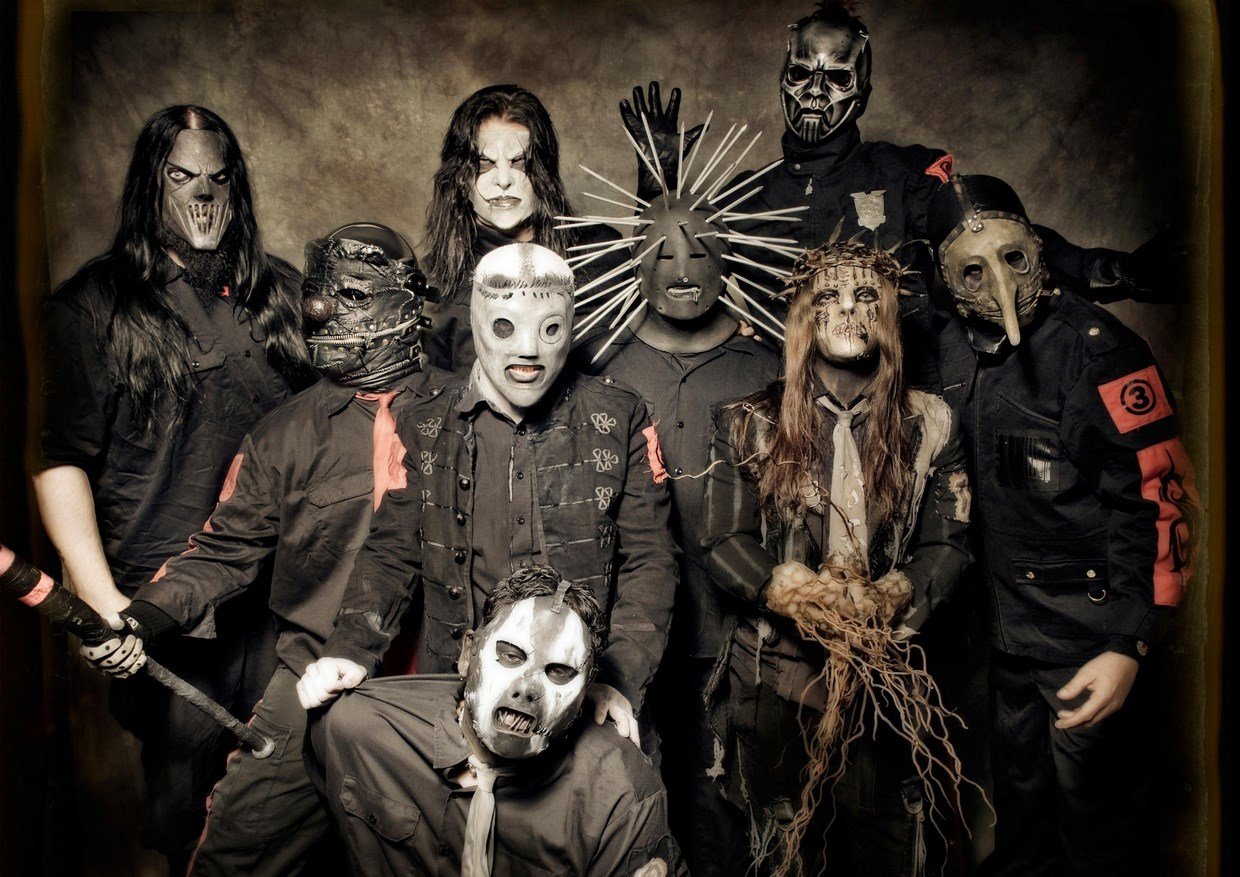
The Masks: Why Does Slipknot Wear Masks?
Slipknot's masks are one of the most distinctive visual identities
in rock and metal, and the reasoning behind them is more
considered than it might initially appear. The band have
consistently described the masks as a way of submerging individual
identity within the collective — when members put on their masks,
they are not nine separate people with separate personalities but
a single entity. The masks equalise them.
Each member designs their own mask, and those designs evolve with
every album cycle. The progression from the raw, homemade look of
the self-titled era masks to the more elaborate designs of later
albums traces the band's own development from an underground act
to an arena-level institution. Corey Taylor's jester and
subsequent designs, Shawn Crahan's clown masks, and the various
grotesque iterations that followed have all become iconic within
metal culture.
The numbered system — each member is referred to by a number
rather than a name — reinforces the same anonymity. The numbers
run from 0 (Sid Wilson, the DJ) to 8 (Corey Taylor, the vocalist),
and while fans know the names behind each number, the numbering
system remains the band's preferred mode of self-reference.
†
In Memory: Paul Gray, #2, was a founding
member, bassist and central creative figure in Slipknot. He died
on 24 May 2010 from an accidental drug overdose, aged 38. His
influence on the band's early sound — particularly the bass work
that anchored the chaos of the self-titled and
Iowa albums — is incalculable.
.5: The Gray Chapter (2014) takes its name partly in
his honour.
Best Slipknot Albums to Hear Next
These are the albums worth exploring in full, with guidance on
which entry point suits which kind of listener.
2004
Vol. 3: The Subliminal Verses
The best starting album for new listeners. Contains
Duality, Before I Forget,
Vermilion and Vermilion Pt. 2. Produced by
Rick Rubin, it is the most musically varied and sonically
polished album in the catalogue while retaining full
Slipknot aggression.
1999
Slipknot
The debut album and still one of the most significant first
statements in metal history. Contains
Wait and Bleed, Eyeless,
Spit It Out and Sic. Rawer and more
chaotic than anything that followed — essential for
understanding where the band came from.
2008
All Hope Is Gone
Contains Psychosocial, Sulfur and
Snuff. The most sonically heavy album in the
catalogue alongside Iowa, but with broader
emotional range. Essential for fans who want maximum
Slipknot with genuine variety of tone.
2001
Iowa
The most extreme Slipknot album and not an easy listen.
Contains People = Shit,
The Heretic Anthem, Disasterpiece and the
16-minute title track. Best approached after the debut and
Vol. 3 — it rewards listeners who are already
committed to the band.
2014
.5: The Gray Chapter
The post-Paul Gray album and a significant creative
achievement under difficult circumstances. Contains
The Devil in I, The Negative One and
Custer. Essential for the full Slipknot story and
stronger as a complete album than its individual tracks
suggest.
Honourable Mentions
Slipknot have a deep catalogue across seven albums and this top 10
can only begin to cover it. Strong tracks with devoted fan
followings that nearly made the ranking include:
-
Spit It Out (1999) — the debut's most ferocious
track, notorious for the "jump the fuck up" moment at live shows
-
People = Shit (Iowa, 2001) — the visceral
centrepiece of the band's most extreme album
-
Disasterpiece (Iowa, 2001) — nine minutes of
escalating aggression that many fans consider the definitive
Iowa-era track
-
The Heretic Anthem (Iowa, 2001) — one of the
most technically demanding performances on the album
-
The Negative One (.5: The Gray Chapter, 2014) —
the most aggressive track from the comeback album
-
Custer (.5: The Gray Chapter, 2014) — a fan
favourite for its frantic energy and blistering pace
-
Unsainted (We Are Not Your Kind, 2019) — the
lead single and most accessible track from the most recent
pre-End So Far album
-
Solway Firth (We Are Not Your Kind, 2019) — the
heaviest and most critically praised track from
We Are Not Your Kind
Slipknot Band History
Slipknot formed in Des Moines, Iowa in 1995, founded initially by
percussionist Shawn Crahan and bassist Paul Gray. The classic
nine-member lineup — which included vocalist Corey Taylor, DJ Sid
Wilson, drummers Joey Jordison and Clown, guitarists Mick Thomson
and Jim Root, and sampler Craig Jones — came together over the
following two years through a series of lineup changes that also
involved vocalist Anders Colsefni before Taylor's recruitment in
1997.
Their independently released debut,
Mate. Feed. Kill. Repeat. (1996), circulated through
Iowa's underground scene before the band signed to Roadrunner
Records and released their major-label self-titled album in 1999.
The combination of extreme metal, hip-hop percussion, theatrical
costuming and raw lyrical honesty was unlike anything the industry
had seen, and the album became one of the fastest-selling debut
records in metal history.
Iowa (2001) pushed further into extremity and documented
a period of serious personal dysfunction within the band —
multiple members were struggling with addiction, and the recording
sessions were volatile and often unsafe. The album nonetheless
received widespread critical acclaim and cemented Slipknot's
status as genuinely dangerous artists rather than shock-value
performers. Vol. 3: The Subliminal Verses (2004),
produced by Rick Rubin, refined their sound toward something more
varied and melodic without diminishing its force, and
Before I Forget's Grammy win gave the band mainstream
validation.
Bassist Paul Gray — #2, a founding member and one of the band's
primary songwriters — died on 24 May 2010 from an accidental
overdose of morphine and fentanyl, aged 38. His death cast a
shadow over everything that followed. Drummer Joey Jordison,
another founding creative force, departed in 2013 under
circumstances that remain contentious; he died in 2021 from a
neurological condition, aged 46.
.5: The Gray Chapter (2014),
We Are Not Your Kind (2019) and
The End, So Far (2022) constitute the band's later era,
recorded with new members including drummer Jay Weinberg and
bassist Alessandro Venturella. All three albums demonstrated
genuine creative ambition and produced tracks that belong in the
band's broader best-of conversation, even if they do not quite
match the intensity of the first four records.
Corey Taylor: The Voice of Slipknot
Corey Taylor is widely regarded as one of the most technically
capable and emotionally versatile vocalists in heavy metal. His
ability to move between melodic clean singing and extreme screamed
delivery — often within the same song — is central to what makes
Slipknot's best material work. The clean choruses would not have
the impact they do without the aggression that precedes them, and
the screamed verses would be exhausting without the melodic
release that follows.
Taylor joined Slipknot in 1997 after fronting a Des Moines band
called Stone Sour, which he later revived as a parallel career
alongside Slipknot. Stone Sour produced commercially successful
albums including Come What(ever) May (2006) and
House of Gold & Bones (2012–2013) that show the
melodic, hard rock side of his writing without the extreme
context.
As a lyricist, Taylor's themes across the Slipknot catalogue —
rage, self-destruction, addiction, grief, identity, the desire for
redemption — are drawn directly from his own life rather than from
theatrical distance. That autobiographical directness is a
significant part of why the songs connect with listeners as
powerfully as they do; the anger and pain in the music is not
performed but reported.
Are Slipknot Touring?
Slipknot remain one of the most powerful and in-demand live acts
in heavy metal, known for productions of considerable scale and
shows that maintain the physical intensity of their debut-era
performances even in arena and festival settings. For current
touring dates and festival appearances, visit the RockHeardle
Tours page.
Slipknot Songs: Frequently Asked Questions
// What is Slipknot's best song?
Duality is widely considered Slipknot's best song. It
balances their most accessible chorus with genuine metalcore
aggression, and became one of the biggest rock songs of the
2000s. It is also the most reliable entry point for new
listeners and the most consistently voted fan favourite across
polls.
// What does Duality by Slipknot mean?
Duality is about the tension between two competing
sides of a person — specifically, the conflict between violent,
destructive impulses and the desire for peace. Corey Taylor has
said the chorus image of pushing fingers into eyes represents
forcing yourself to confront what you would rather not see. The
duality of the title is not good versus evil but two kinds of
self that cannot be entirely separated.
// What does Psychosocial by Slipknot mean?
Psychosocial examines how psychological and social
forces are used to manipulate and divide people — through media,
religion, tribalism and propaganda. The title names the
mechanism (the intersection of individual psychology and group
social behaviour), and the song argues that this is where most
organised human destruction begins.
// Why does Slipknot wear masks?
Slipknot wear masks as both an artistic statement and a
psychological device. The masks allow members to submerge their
individual identities within the collective entity of Slipknot.
Each member designs their own mask, which evolves across album
cycles. The mask system reinforces the same anonymity as the
numbered member system — members are traditionally referred to
by number rather than name.
// Who is the vocalist of Slipknot?
Corey Taylor (#8) is the vocalist of Slipknot. He is known for
combining melodic clean singing with aggressive screamed vocals
— often within the same song — and is widely regarded as one of
the most technically capable and emotionally versatile vocalists
in heavy metal. He also fronts the hard rock band Stone Sour.
// How many members does Slipknot have?
Slipknot currently have eight members, down from the classic
nine-member lineup. The current band includes Corey Taylor
(vocals), Sid Wilson (DJ/turntables), Jim Root (guitar), Mick
Thomson (guitar), Craig Jones (samples/media), Shawn Crahan
(percussion), Jay Weinberg (drums) and Alessandro Venturella
(bass). Members are traditionally referred to by number.
// Who was Paul Gray?
Paul Gray (#2) was Slipknot's original bassist and a central
creative force in the band. He was a founding member and
contributed significantly to the songwriting across the first
four albums. He died on 24 May 2010 from an accidental overdose
of morphine and fentanyl, aged 38.
.5: The Gray Chapter (2014) takes its name partly in
his honour.
// What is the best Slipknot album for beginners?
Vol. 3: The Subliminal Verses (2004) is the best
starting album for new listeners — it contains Duality,
Before I Forget and Vermilion and represents
the most musically varied and melodically accessible version of
the Slipknot sound. The self-titled debut (1999) is the right
starting point for listeners who want the rawest and most
chaotic version of the band.
// What does Vermilion by Slipknot mean?
Vermilion is written from the perspective of an
obsessive, all-consuming attachment to another person who has
become an idealised, impossible figure in the narrator's mind.
The vermilion colour references passion (red) and destruction
(blood). Vermilion Pt. 2 presents the same emotional
situation in a stripped-back acoustic form — the two tracks work
as companion pieces.
// Where are Slipknot from?
Slipknot are from Des Moines, Iowa, USA. They formed in 1995 and
spent three years in Iowa's underground music scene before their
Roadrunner Records debut in 1999 brought them to national and
international attention. Des Moines is prominently referenced in
their identity and mythology.
Explore More Rock & Metal Guides