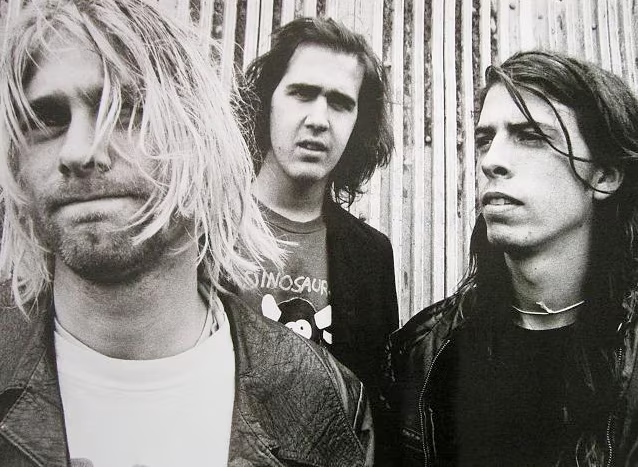
What Makes a Great Nirvana Song?
A great Nirvana song is built on a tension between two things that
should not coexist as comfortably as they do: pop melody and rock
brutality. Kurt Cobain had an instinct for hooks that came from
the Beatles and the Pixies simultaneously — he could write a
chorus that sounds like it was always there, waiting to be
discovered, and then surround it with noise that makes the melody
feel both more necessary and more fragile by contrast.
Nirvana formed in Aberdeen, Washington in 1987 — Cobain and
bassist Krist Novoselic brought together by a shared love of punk
rock, heavy metal and the underground American rock scene that was
developing around labels like Sub Pop and SST. Aberdeen itself is
significant context: a small, isolated logging town on the coast
of the Pacific Northwest, economically depressed and culturally
cut off, it shaped Cobain's outsider sensibility and gave his
writing its specific combination of provincial longing and raw
anger.
Dave Grohl joined as drummer in 1990, completing the lineup that
recorded Nevermind and In Utero. His arrival
transformed the band's live and recorded sound — the energy, the
physicality, the sheer controlled force of the drumming on those
albums is the engine that everything else runs on. The three-piece
format was both a practical choice and a philosophical one: Cobain
wanted nothing that was not absolutely necessary.
This ranking attempts something slightly unusual: it does not
place Smells Like Teen Spirit at number one. Not because
the song is not great — it obviously is — but because the most
famous Nirvana song is not, on close listening, the best one. The
best ones are quieter, stranger, and more personally revealing.
This ranking is built around that conviction.
Top 10 Nirvana Songs Ranked
Something in the Way closes Nevermind in a
way that no one expected from a record that opened with
Smells Like Teen Spirit. Everything is stripped back
to almost nothing: a quiet, repetitive guitar figure, Cobain's
voice barely above a whisper, a cello that enters partway
through and pulls the song's sadness to the surface. It is a
song about exhaustion, poverty and the peculiar peace of
having given up on trying to fit in — not angry, not defiant,
just quietly and completely at the end of some kind of road.
The recording itself has a famous story attached to it: Cobain
allegedly recorded the vocal lying on the studio floor because
the song required the feeling of being horizontal, unable to
rise. Whether literally true or not, that image captures the
song's quality perfectly. It is music that knows what it feels
like to not be able to get up, and it does not pretend that
feeling is anything other than what it is.
Its 2022 resurgence via the Batman film brought it to
an entirely new generation and introduced millions of
listeners to Nirvana through their most unusual, most intimate
track — which is an entirely fitting entry point. The song
received the mainstream recognition its quality deserved
thirty years after its original release.
Song Meaning
Something in the Way is associated with a period
Cobain claimed to have spent living under the Young Street
Bridge in Aberdeen, Washington after his parents' divorce,
surviving on food taken from convenience stores. The
biographical details are disputed — family members have said
he spent nights there occasionally but did not actually live
there — but the emotional truth the song captures is
entirely real: isolation, resourcelessness, and a kind of
defeated acceptance of being outside normal life. The
"animals I've trapped" line suggests squatting in a space
that does not belong to him; the "dripping" of the ceiling
returns through the track as a physical detail that grounds
the abstract loneliness.
// Why #1: Nirvana at their most intimate,
most unguarded and most nakedly honest. The song that shows
who Cobain was when the performance dropped away completely.
Heart-Shaped Box is the finest song on
In Utero and one of the most lyrically dense and
sonically accomplished things Nirvana ever recorded. The
opening guitar figure is immediately distinctive — a
controlled, ominous riff that establishes the song's
atmosphere before a note has been sung — and the
verse-to-chorus dynamic is the quiet/loud principle at its
most precisely calibrated.
The lyric is Cobain at his most surreal and most personal
simultaneously: the imagery is vivid and disturbing (umbilical
nooses, meat-eating orchids, a witch burning in a ditch) but
the emotion underneath is raw and recognisable — obsessive
love, helplessness, the feeling of being trapped inside
something beautiful that is also consuming you. It is a love
song written in a language that refuses to be comfortable.
The production from Steve Albini gives the track a physical
harshness that the polished Nevermind sound would not
have served — the drums feel like they are in the same room as
you, and the guitar in the loud sections has an abrasive edge
that matches the lyric's unease. It is the track that best
shows what In Utero was trying to do with its sound.
Song Meaning
Heart-Shaped Box is widely interpreted as being
about Cobain's relationship with Courtney Love — the
heart-shaped box a metaphor for a consuming, obsessive
attachment from which he cannot free himself. Cobain said in
interviews that the song was about children with cancer and
the helplessness of watching innocents suffer, and that
dimension is also present. The two interpretations are not
mutually exclusive: the helplessness of loving someone you
cannot save and the helplessness of watching children die
share the same emotional core.
// Why #2: Cobain's most lyrically
sophisticated song and the finest thing on In Utero —
visceral, beautiful and deeply strange in equal measure.
Smells Like Teen Spirit is one of the most culturally
significant songs ever recorded and the track that, in
September 1991, ended one era of popular music and began
another. The riff is built on a Pixies quiet-loud structure
that Cobain acknowledged borrowing, but what he did with it —
the melodic hook, the chorus's explosive release, Butch Vig's
production — created something that transcended its influences
completely.
It is ranked third here not because it is a lesser song than
those above it but because the scale of its fame has somewhat
obscured what it actually is: a deliberately incoherent,
slightly absurdist piece of noise-pop that Cobain himself
found confusing in its success. He had written catchier
choruses and stranger verses and better lyrics. The
combination of those elements in this specific configuration,
on this specific production, at this specific cultural moment,
produced something unprecedented — but the song is not the
peak of his craft in the way its fame implies.
Song Meaning
Cobain said the lyrics were largely meaningless — assembled
for their sound rather than their sense — and that he was
embarrassed by how little the words actually said. The title
came from a phrase Kathleen Hanna of Bikini Kill
spray-painted on his wall: "Kurt smells like Teen Spirit," a
reference to the deodorant brand his girlfriend at the time
wore. He took it as a revolutionary slogan without knowing
its source. The song's generational resonance came from the
feeling rather than the lyric — the video's imagery of
teenage alienation and the chorus's release captured
something the audience recognised before they understood
why.
// Why #3: the most important rock song of
the 1990s and arguably in the last fifty years — but not
Cobain's best piece of writing, and honestly ranked here for
that reason.
Come as You Are is the most immediately and lastingly
beautiful song on Nevermind — more melodically
graceful than Teen Spirit, more emotionally open, and
built around a guitar riff that is one of Cobain's most purely
musical moments. The chorus is both an invitation and
something more ambiguous: "come as you are, as you were, as I
want you to be" is simultaneously accepting and possessive,
welcoming and demanding.
The verse's hypnotic, water-like guitar figure (partially
inspired by a Killing Joke riff, though the similarity was
contested) creates an atmosphere of suspension that is unlike
anything else on the album, and the production allows each
element — Novoselic's bass, Grohl's drums, the guitar — to sit
in its own space with unusual clarity. It is the most
arrangement-conscious thing Cobain ever recorded.
Song Meaning
Come as You Are is a song of conditional acceptance
— an invitation to someone to be themselves, with the
unstated caveat that Cobain also needs to define what
"yourself" means. He described it as being about the
contradictions in people and how those contradictions can be
accepted rather than resolved. The repeated "and I swear
that I don't have a gun" is both literal (a reference to his
discomfort with weapons despite growing up in gun culture)
and a reassurance: this is not a threat, I want you here.
// Why #4: the most purely melodic Nirvana
song and the best evidence of Cobain's gift for writing guitar
riffs that feel like they describe an emotional state rather
than just a chord sequence.
Lithium is the most structurally and emotionally
sophisticated track on Nevermind — a song that
dramatises the simultaneous experience of depression and
religious mania with a vividness and psychological precision
that most pop songs cannot approach. The verse is numb and
flat, the voice defeated; the chorus explodes into something
that sounds like joy but is immediately undercut by the
realisation that the joy is a symptom rather than a
resolution.
Cobain described the song as being about a character who turns
to religion after losing everything, finding in it a euphoria
that is entirely hollow but temporarily functional. The word
"lithium" is the medication used to treat bipolar disorder,
and the song's emotional structure — the crash of the verse,
the manic spike of the chorus — mirrors that condition with an
accuracy that feels more than metaphorical.
Song Meaning
Lithium is a character study of someone using
religion as a pharmaceutical — a way to manage emotional
extremity rather than a genuine act of faith. Cobain was
interested in the social function of belief systems and the
way they can substitute for rather than complement genuine
human connection. The character in the song has lost
everything, found God, and is now high on the discovery:
"I'm so happy 'cause today I found my friends / They're in
my head." The friends are not real. The happiness is not
stable. The lithium of the title is what you take when
nothing else is working.
// Why #5: Cobain's most psychologically
precise lyric and the most complete example of the quiet/loud
dynamic being used not just as a production technique but as
an emotional argument.
All Apologies closes In Utero as
Something in the Way closes Nevermind — with
quiet, with acceptance, with an exhaustion that has moved past
anger into something almost peaceful. But where
Something in the Way is isolated and specific,
All Apologies is addressed to someone: a song of
accountability and self-accusation that is also,
paradoxically, a love song.
The MTV Unplugged version is frequently cited as the
definitive recording and it is genuinely extraordinary —
Cobain's voice in that performance has a fragility and control
that the In Utero version does not quite match, and
the stripped arrangement makes the melody feel newly exposed.
"In the sun I feel as one" is one of the most simply beautiful
lines Cobain ever wrote, and the performance gives it the
space it requires.
Song Meaning
All Apologies is widely interpreted as Cobain's
apology to Courtney Love and their daughter Frances Bean —
an acknowledgement of the damage his own instability and
self-destruction caused the people closest to him. The
repeated "all in all is all we are" that closes the song is
both a resignation and a kind of peace: this is everything,
this moment, this acknowledgement. The dedication to Frances
Bean in the liner notes of the In Utero album
suggests the song's primary audience. He played it last on
MTV Unplugged.
// Why #6: the most emotionally complete
Nirvana song — and the MTV Unplugged performance is the single
most affecting thing any of them ever recorded.
Rape Me is the most misunderstood song in the Nirvana
catalogue and one of the most deliberately provocative in its
mismatch between title and intent. Cobain wrote it as an
anti-rape song — specifically as a song about the experience
of violation and the demand for the violator to confront what
they have done. The title is the victim speaking to the
perpetrator, not the perpetrator to the victim.
Musically, it is a mirror of
Smells Like Teen Spirit — the same verse/chorus
dynamic, the same key, a deliberate structural echo that
Cobain used to force the comparison. If Teen Spirit was the
voice of a generation being celebrated, Rape Me was
that same generation being violated by its own celebrity. The
song was banned from MTV and created significant controversy,
which Cobain found both predictable and evidence of exactly
the media hypocrisy it was written to address.
// Why #7: Cobain's most overtly political
song and the most deliberately confrontational — essential for
understanding the tension between his values and his fame.
About a Girl is the earliest indication that Cobain
was a melodic songwriter of genuine originality, written
before the band had recorded an album and notable for being
almost entirely unlike everything else on Bleach.
Where the rest of that record is relentlessly heavy and
abrasive, About a Girl is a pop song — short,
melodically immediate, structured around a verse-chorus
relationship that shows the Beatles influence Cobain carried
throughout his life but rarely displayed this openly.
The MTV Unplugged version, like
All Apologies, strips the song to its essence and
reveals how strong the melody actually is. It is the Nirvana
track that most clearly shows the pop sensibility that Cobain
channelled into punk energy — and the discomfort he felt about
that instinct, which he treated simultaneously as a gift and a
betrayal.
// Why #8: the earliest Nirvana pop song and
the best evidence of Cobain's Beatles-derived melodic instinct
— a song that should not have existed on Bleach but changed
everything once it did.
Drain You is Cobain's own favourite Nirvana song — he
said so repeatedly in interviews and demonstrated it by
playing it at almost every live show with a consistency he did
not extend to even Teen Spirit. It is easy to
understand why: the song achieves everything he was trying to
do with a directness and economy that makes it feel
effortless. The mutual dependency of the lyric (both parties
need and drain each other equally), the guitar hook, the
mid-section noise breakdown — every element is exactly right.
It is one of the most underrated tracks in the
Nevermind sequence precisely because it sits between
bigger songs and because its emotional subject — the draining
intimacy of a close relationship — is less dramatically
expressible than the alienation or mania of the surrounding
material. But Cobain knew it was special, and his instinct was
correct.
// Why #9: Kurt Cobain's own favourite
Nirvana song — which is the only recommendation it needs, and
which turns out to be entirely justified on repeated
listening.
Where Did You Sleep Last Night is not a Nirvana
original — it is a traditional folk/blues song recorded
definitively by Lead Belly and covered by Cobain at the
MTV Unplugged session in November 1993. It is
included here because it is one of the most extraordinary
vocal performances in rock history and because it represents
Cobain at his most completely unguarded.
The performance closes MTV Unplugged in New York with
a sustained note in the final chorus that sounds like
everything Cobain had ever felt being released at once. It is
not a controlled artistic choice — it is a human being singing
with everything they have, past the point of technique into
something else entirely. The band around him reacts; you can
hear them feel it. In the context of what happened five months
later, the performance is almost unbearable to watch.
Cobain chose the song because of his deep love of Lead Belly
and American roots music, which ran alongside his punk
influences throughout his life and was as formative. The cover
connects the Seattle grunge tradition to the American folk
tradition in a way that was unusual and entirely sincere.
// Why #10: not a Nirvana original but the
most emotionally devastating performance in the catalogue —
the point where craft ends and something beyond it begins.
Best Nirvana Songs for Beginners
New to Nirvana? These six tracks introduce the different
dimensions of what the band did — the famous noise-pop anthems,
the quiet intimate moments, the folk roots and the live intensity.
Smells Like Teen Spirit
Start here if you want the cultural context — the most
important rock song of the 1990s and the sound of a moment
changing.
Come as You Are
Start here if you want the melody — the most graceful Nirvana
song and the best evidence of Cobain's pop instincts.
Heart-Shaped Box
The essential In Utero track — visceral, beautiful and the
fullest realisation of Cobain's lyric writing.
Something in the Way
The quietest and most intimate Nirvana song — start here if
you want to understand who Cobain actually was.
All Apologies (Unplugged)
The MTV Unplugged version — one of the most affecting
performances in rock history. Start here and then watch the
whole show.
About a Girl
The earliest Nirvana pop song — shows the Beatles influence
and the melodic core beneath the noise.
Nevermind vs In Utero: Which is Better?
The debate between Nirvana's two major albums is one of the most
enduring in alternative rock. They are genuinely different records
with different strengths, and the answer depends on what you value
most.
Nevermind
1991 — produced by Butch Vig
The more immediately accessible and commercially successful
album — polished, melodic, built for radio even as it
subverted it. Contains Smells Like Teen Spirit,
Come as You Are, Lithium and
Something in the Way. The best starting point for new
listeners and the album that defined an era. Cobain later
resented its polish and the audience it attracted, which gave
rise to In Utero.
In Utero
1993 — produced by Steve Albini
Rawer, harsher, angrier and more lyrically unguarded than
Nevermind — deliberately designed to alienate the
casual audience the previous record had attracted. Contains
Heart-Shaped Box, All Apologies,
Rape Me and
Frances Farmer Will Have Her Revenge on Seattle. Many
critics consider it the more artistically honest statement and
Cobain's truest expression of who he was.
MTV Unplugged in New York: The Essential Live Recording
MTV Unplugged in New York, recorded in November 1993 and
released posthumously in November 1994, is one of the most
important live recordings in rock history. Cobain used the format
to do something unexpected: rather than replicate the
Nevermind hits in acoustic form, he assembled a setlist
that was almost perversely uncommercial — heavy on covers (Lead
Belly, David Bowie, the Meat Puppets), light on the obvious
singles, and structured around the quieter, more intimate side of
the catalogue.
The result is a document of a performer at the very peak of their
musicianship and simultaneously somewhere very dark. Cobain
performed the show surrounded by lilies and black candles — the
production design of a funeral — and the performances have a
quality of concentrated, final-seeming attention that is difficult
to watch without the knowledge of what happened five months later.
For listeners who know Nirvana only through the studio albums, the
Unplugged record is essential and transformative. The versions of
About a Girl, Come as You Are,
All Apologies and
Where Did You Sleep Last Night are among the most
affecting recordings any of the band members made in any context.
It is not a substitute for the studio albums but it is an
essential companion to them.
Kurt Cobain: The Songwriter
Kurt Donald Cobain was born in Aberdeen, Washington on 20 February
1967. His parents divorced when he was eight years old and he has
described the experience as devastating — a loss of stability and
belonging that shaped his self-perception as an outsider from that
point forward. He was a child who drew and painted compulsively,
who loved music from an early age and who found in punk rock a
language for experiences that mainstream culture had no vocabulary
for.
As a songwriter, Cobain's gifts were complementary and somewhat
contradictory: he had an instinct for pop melody that was
essentially classical — he could write a hook that lodged itself
in the memory immediately and without apparent effort — and he had
a lyric sensibility that was drawn to the strange, the surreal and
the personally painful. The tension between those two impulses
produced his best work, where the most accessible melodies carry
the most uncomfortable material.
He was also a guitarist of considerable originality within a
limited technical range. His riffs are not complex by the
standards of contemporary hard rock players, but they are
immediately identifiable and sonically distinctive — the result of
an ear that cared intensely about tone and atmosphere and very
little about virtuosity. His influences included the Beatles, the
Pixies, the Vaselines, Lead Belly, Daniel Johnston and a range of
punk bands whose names were less important than the attitude they
modelled.
Cobain struggled throughout his career with severe chronic stomach
pain of disputed origin, with addiction to heroin, with the
discomfort of fame and with depression. He was open about these
struggles in interviews while being resistant to the therapeutic
and commercial frameworks that surrounded him. He died on 5 April
1994, aged 27, from a self-inflicted gunshot wound at his home in
Seattle. His suicide note, addressed to his childhood imaginary
friend, is one of the most discussed documents in rock history.
†
Kurt Cobain (20 February 1967 — 5 April 1994)
was found dead at his Lake Washington home in Seattle on 8 April
1994. He was 27 years old. His death marked the effective end of
Nirvana, though Krist Novoselic and Dave Grohl continued to work
together on the posthumous releases that followed. Cobain's
influence on guitar-based music in the subsequent thirty years
is without parallel among artists of his generation.
Dave Grohl and What Came After
Dave Grohl joined Nirvana in September 1990, replacing Chad
Channing, who had drummed on Bleach. His addition to the
band was transformative: the combination of power, control and
musicality he brought to the drum parts on Nevermind and
In Utero is a central reason both albums sound the way
they do. No other drummer would have served those recordings as
well.
Following Cobain's death, Grohl founded Foo Fighters, recording
and playing all the instruments on the debut album himself before
expanding it into a full band. Foo Fighters became one of the most
successful rock bands of the following three decades — a
remarkable creative achievement in its own right, and one that
inevitably exists in the shadow of what preceded it.
Krist Novoselic, meanwhile, remained active in music and shifted
significant attention toward political activism, particularly
around electoral reform and the rights of musicians. Both
surviving members have participated in reunions and tribute events
over the years, and their relationship with the Nirvana legacy has
been thoughtful and protective without being exploitative.
Best Nirvana Albums to Hear Next
1991
Nevermind
The best starting album for most new listeners. Contains
Smells Like Teen Spirit, Come as You Are,
Lithium, Polly, Drain You and
Something in the Way. One of the best-selling and
most influential albums in rock history, produced by Butch
Vig with a clarity and punch that made it immediately
accessible without losing any of the band's essential
tension.
1993
In Utero
The rawer, harsher follow-up and many critics' choice as the
more artistically honest record. Contains
Heart-Shaped Box, All Apologies,
Rape Me and Frances Farmer. Produced by
Steve Albini with a deliberate lo-fi aggression that was
Cobain's response to the polished accessibility of
Nevermind.
1994
MTV Unplugged in New York
The essential live document and in some ways the most
emotionally important Nirvana recording. The setlist — heavy
on covers and quieter material — is as much a statement of
aesthetic values as a live performance, and the performances
are extraordinary. Includes the definitive versions of
About a Girl, All Apologies and
Where Did You Sleep Last Night.
1989
Bleach
The debut album and the sound of Nirvana before
Nevermind's production polish. Contains
About a Girl, School and
Negative Creep. Heavier and less melodically
developed than what followed, it is essential for
understanding the Sub Pop underground context and for
hearing About a Girl in its original setting.
Honourable Mentions
Nirvana's catalogue is compact — three studio albums, one live
record — but the quality across those records and the B-sides and
rarities that accompanied them is remarkable. Strong tracks that
nearly made the top 10 include:
-
Polly (Nevermind, 1991) — a disturbing
narrative written from a predator's perspective, which Cobain
used to explore the psychology of violence; one of his most
formally unusual songs
-
In Bloom (Nevermind, 1991) — a song of
self-aware ambivalence about the audience Nirvana was
attracting, with one of Cobain's best melodies
-
Frances Farmer Will Have Her Revenge on Seattle
(In Utero, 1993) — a tribute to the actress Frances
Farmer that doubles as Cobain's most explicit statement about
the entertainment industry's treatment of artists
-
Oh, Me (MTV Unplugged, 1994) — a Meat
Puppets cover that Cobain performed with the Meat Puppets' own
members at the Unplugged session; arguably the most joyful thing
in the catalogue
-
The Man Who Sold the World (MTV Unplugged, 1994) — the Bowie cover that introduced many listeners to
both Nirvana and David Bowie, delivered with complete ownership
of the original
-
Sliver (single, 1990) — one of Cobain's most
autobiographically revealing early songs, written about being
left with his grandparents as a child; the melody is
extraordinary
-
Lake of Fire (MTV Unplugged, 1994) —
another Meat Puppets cover, dark and sparse, with a vocal
performance from Cobain that demonstrates his range
Nirvana and the Grunge Era
Nirvana did not invent grunge — the genre had been developing in
the Pacific Northwest throughout the late 1980s, with bands like
Mudhoney, Soundgarden, Alice in Chains and Green River working out
the combination of punk energy, heavy metal weight and alternative
rock sensibility that would come to define the scene. What Nirvana
did was take those elements and add something that most of their
Seattle contemporaries did not have: the kind of pop songwriting
that reached beyond the underground.
The release of Nevermind in September 1991 displaced
Michael Jackson's Dangerous from number one on the
Billboard 200 in January 1992 — a cultural shift of extraordinary
significance that neither the band nor the industry had
anticipated. Virtually overnight, the major labels began signing
grunge and alternative rock bands, MTV shifted its programming,
and the mainstream rock landscape of the following decade was
shaped by decisions made in reaction to that chart position.
Cobain was deeply uncomfortable with this outcome. His contempt
for corporate rock and mainstream culture — genuine, consistent
and expressed constantly in interviews — meant that success felt
to him like a kind of failure. He had written
Smells Like Teen Spirit partly as a critique of the
passivity and conformity of his generation; watching that
generation adopt it as an anthem confirmed rather than resolved
his concerns.
Nirvana's Legacy
Nirvana were inducted into the Rock and Roll Hall of Fame in 2014,
in their first year of eligibility. The induction performance
featured guest vocalists including Paul McCartney, Kim Gordon, St.
Vincent and Joan Jett — a lineup that illustrated the range of
musical traditions Nirvana had simultaneously inhabited and
influenced.
The band's influence on subsequent rock music is difficult to
overstate. The quiet/loud dynamic they popularised became a
structural template for an enormous range of bands. The idea that
heavy, aggressive music could be openly emotional and melodic
rather than stoic and macho opened space for decades of
alternative metal, post-hardcore and emo that followed. The
cultural permission to be both angry and vulnerable
simultaneously, which Nevermind granted to a generation
of listeners, has not expired.
For current information on Nirvana-related events, exhibitions,
and related artist tours, visit the RockHeardle
Tours page.
Nirvana Songs: Frequently Asked Questions
What is Nirvana's best song?
While Smells Like Teen Spirit is Nirvana's most famous
song, many fans and critics consider
Something in the Way, Heart-Shaped Box or
Lithium to be their best work — more lyrically precise
and more representative of Cobain's writing at its most
unguarded. This ranking places Something in the Way at
#1 as the most intimate and emotionally honest Nirvana track.
What does Smells Like Teen Spirit mean?
The title came from a phrase Kathleen Hanna of Bikini Kill
spray-painted on Cobain's wall: "Kurt smells like Teen Spirit" —
a reference to a deodorant brand. Cobain took it as a
generational rallying cry without initially knowing its source.
He later said the lyrics were largely meaningless, assembled for
sound rather than sense, and that he was uncomfortable with how
much the song was taken as a literal statement of belief.
What does Heart-Shaped Box mean?
Heart-Shaped Box is widely interpreted as being about
Cobain's relationship with Courtney Love — the heart-shaped box
a metaphor for obsessive, consuming attachment. Cobain also said
it was about children with cancer and the helplessness of
watching innocents suffer. Both interpretations describe the
same emotional core: being trapped inside something you love but
cannot save.
What does Something in the Way mean?
Something in the Way is associated with a period Cobain
claimed to have spent living under the Young Street Bridge in
Aberdeen after his parents' divorce — surviving on food taken
from convenience stores, surrounded by discarded animals. The
biographical details are contested, but the emotional truth of
isolation, poverty and defeated acceptance is entirely real
regardless of the literal circumstances.
Who was Kurt Cobain?
Kurt Cobain (1967–1994) was the vocalist, guitarist and primary
songwriter of Nirvana. Born in Aberdeen, Washington, he
co-founded Nirvana with Krist Novoselic in 1987. Known for
combining pop melody with punk aggression and deeply personal,
often surreal lyrics. He died on 5 April 1994, aged 27, from a
self-inflicted gunshot wound. His influence on rock music in the
following three decades is without parallel among artists of his
generation.
Nevermind or In Utero — which Nirvana album is better?
Both are essential. Nevermind is more accessible and
melodically immediate; In Utero is rawer, harsher and
more lyrically unguarded. Cobain considered
In Utero the more honest statement and was
uncomfortable with the polish of Nevermind. Most
serious listeners consider both indispensable and appreciate
them as two sides of the same creative sensibility.
Who is Dave Grohl?
Dave Grohl joined Nirvana as drummer in 1990 and played on
Nevermind and In Utero. After Cobain's death
he founded Foo Fighters, recording the debut album himself
before expanding to a full band. Foo Fighters became one of the
most successful rock acts of the following three decades. Grohl
is widely considered one of the most important drummers in rock
history.
What is the best Nirvana album to start with?
Nevermind (1991) is the best starting album for most
new listeners — it contains the most famous songs and its
production makes it immediately accessible. In Utero is
the right second step, MTV Unplugged the essential live
record, and Bleach the important historical foundation.
Where are Nirvana from?
Nirvana formed in Aberdeen, Washington — a small, isolated
logging town on the Pacific Northwest coast. They later
relocated to the Seattle area, which was the centre of the
grunge movement. Aberdeen's economic depression and cultural
isolation are significant context for Cobain's outsider
perspective and the specificity of his writing.
What did Kurt Cobain say was his favourite Nirvana song?
Cobain consistently cited Drain You as his personal
favourite Nirvana song — playing it at nearly every live show
and mentioning it repeatedly in interviews as the track he was
most satisfied with. He found the song's subject (mutual
emotional dependency) and its construction more interesting than
the bigger hits he was expected to champion.