What Makes a Great Iron Maiden Song?
A great Iron Maiden song occupies a category of its own in heavy
metal — the specific combination of Steve Harris's galloping,
melodic bass lines, the twin (and later triple) guitar harmonies
that define the sound, the compositional ambition of the extended
pieces and Bruce Dickinson's operatic tenor delivering narratives
drawn from history, mythology, literature and the full range of
human experience. Iron Maiden do not write about the quotidian;
they write about the Charge of the Light Brigade, the fall of
Icarus, the pharaoh contemplating mortality, the Battle of
Britain.
Iron Maiden formed in Leyton, East London in 1975 — Steve Harris
as the creative foundation, the lineup evolving through several
configurations before the classic era stabilised with Bruce
Dickinson replacing Paul Di'Anno in 1982. The British Steel-era
New Wave of British Heavy Metal context placed them alongside
Judas Priest and Motörhead, but Iron Maiden's specific combination
of literary ambition, musical complexity and Eddie's visual
identity quickly distinguished them as something sui generis.
This ranking concentrates on the classic era (1982–1992) where the
songwriting quality is highest, while acknowledging the finest
moments from the reunion albums.
Hallowed Be Thy Name first, The Trooper second,
and the case for both is made below.
Top 10 Iron Maiden Songs Ranked
Hallowed Be Thy Name is the greatest Iron Maiden song
and one of the greatest heavy metal songs ever recorded — a
seven-minute piece that tracks a condemned man's final walk to
the gallows with such emotional precision and such musical
power that it has accumulated a near-universal consensus
across four decades of debate about the genre's finest
moments. The song has been covered by dozens of bands across
multiple genres, voted to the top of countless polls and
performed at virtually every Iron Maiden concert since 1982.
The song builds from a tolling bell into one of Harris's
finest bass-driven introductions before the twin guitars of
Murray and Smith enter with the harmony figure that will
anchor the whole piece. Dickinson's vocal — beginning measured
and almost conversational as the condemned man surveys his
situation, building through the lyric's philosophical
escalation to the final, desperate shriek — is one of his
finest studio performances. The guitar harmonies in the
verses, the solo section's emotional scale and the final
acceleration all combine into something that earns its status
as a masterpiece rather than simply inheriting it.
The lyric's journey — from the specific terror of the
condemned man's final morning through philosophical
questioning of death, afterlife and the nature of existence,
to a kind of transcendent acceptance — is the finest piece of
writing in the Iron Maiden catalogue. The line "I'm not afraid
of dying / I know I will be reborn" arriving in the final
section as the music reaches its peak creates one of the most
dramatically effective moments in heavy metal songwriting.
Song Meaning
Hallowed Be Thy Name is written from the
perspective of a man condemned to hang — tracking his
thoughts and emotional journey through the final morning,
the walk to the scaffold, and the moment of execution. Steve
Harris has described being influenced by the specific horror
of capital punishment and by Dylan Thomas's poem "Do Not Go
Gentle into That Good Night." The lyric moves from fear
through philosophical questioning (what lies beyond death?
does any of it mean anything?) to a final, fragile
acceptance. The title inverts the Lord's Prayer — not a
rejection of God but a desperate, honest engagement with the
question of what any of this means in the face of death.
Why #1: the greatest Iron Maiden song and one
of the greatest heavy metal recordings ever made — seven
minutes of emotional, musical and lyrical achievement that no
other Maiden track approaches.
The Trooper is Iron Maiden's most kinetically perfect
song — a track that achieves complete unity of form and
content, its galloping rhythm being literally the sound of
cavalry charging into battle, its melody being simultaneously
a guitar harmony and a warcry, its narrative voice being that
of a soldier who knows he is likely to die but charges forward
regardless. It is Iron Maiden at their most viscerally
immediate, and no other track in the catalogue — not even
Hallowed Be Thy Name — creates its particular
physical effect.
Steve Harris wrote it about the Charge of the Light Brigade —
the catastrophic British cavalry charge at the Battle of
Balaclava in 1854, immortalised in Tennyson's poem and one of
the defining military disasters in British history. The
specific knowledge of that source is not necessary to
experience the song's impact, but it deepens the appreciation
of the narrative and of the specific combination of pride,
courage and doomed loyalty that the lyric captures.
Song Meaning
The Trooper is narrated by a British cavalry
soldier during the Charge of the Light Brigade at Balaclava
(1854) — one of the most famous military disasters in
British history, in which cavalry were ordered to charge
directly into Russian artillery due to a miscommunication.
The soldier knows the charge is suicidal but follows orders
and charges forward anyway. The lyric captures the specific
combination of military loyalty, courage and the awareness
of imminent death that Tennyson's poem immortalised. The
galloping bass and drum pattern is literal — the sound of
horses running at full speed toward cannon fire.
Why #2: the most kinetically perfect Iron
Maiden song — form and content in complete unity, the
galloping rhythm literally the sound of cavalry charging, one
of the most physically immediate tracks in the genre.
Fear of the Dark is the finest track on the final
album of the classic Bruce Dickinson era and the Iron Maiden
song with the most remarkable live identity — a piece that
builds through a quiet, acoustic-flavoured opening into one of
the most powerful heavy metal choruses in the genre's history,
and that at full volume in a darkened stadium becomes one of
the most genuinely uncanny experiences in rock. When fifty
thousand people shout "Fear of the dark / I have a constant
fear that something's always near" in the dark, the song earns
its title.
The song's journey — from the quiet, slightly menacing opening
through the mounting tension of the verse to the release of
the chorus — mirrors the experience of anxiety it describes.
The fear of darkness is treated not as childish irrationality
but as a genuine psychological phenomenon that the lyric's
narrator shares, which gives the song an emotional
authenticity that connects it to listeners across the full
range of their experience with anxiety and the irrational.
Song Meaning
Fear of the Dark is about the primal, irrational
fear of darkness that many people experience even in
adulthood — the specific sensation of something malevolent
present in the dark that the conscious mind knows is not
real but that older, deeper brain responses continue to
insist is. Bruce Dickinson has described it as the most
directly personal Iron Maiden lyric he has written — a
genuine account of his own experience of this fear. The song
treats the fear as entirely legitimate rather than as
something to be embarrassed about, which is part of its
power.
Why #3: the finest late classic-era Maiden
track and the song with the most extraordinary live identity —
fifty thousand people in the dark shouting about darkness is
one of the great rock experiences.
Aces High opens Powerslave without preamble
— a brief Churchill speech sample gives way to the most
furious introductory passage in the Iron Maiden catalogue, and
the song does not stop for breath until it is finished. It is
Iron Maiden at their absolute fastest and most aggressive, and
the combination of that speed with the precision of the
arrangement (every instrument exactly where it needs to be,
Harris's bass driving beneath guitar harmonies that never
slip) demonstrates the specific capability that separates Iron
Maiden from their contemporaries even at maximum velocity.
The song is about the Battle of Britain — the RAF fighter
pilots who defended British airspace in 1940 — and the
specific combination of pride, terror and adrenaline of aerial
combat is captured in the tempo and the aggression of the
music as effectively as any description in words could
achieve. The Churchill quotation opening is one of the great
album opening gestures in rock history.
Why #4: the fastest and most aggressive Iron
Maiden opening track — the Battle of Britain compressed into
four minutes of ferocious precision, Churchill to the first
riff with no mercy.
The Number of the Beast is Iron Maiden's most famous
song to the widest audience and the track most associated with
the band by listeners who may not be deeply familiar with the
catalogue. The opening Vincent Price sample, the galloping
riff, the "666 — the number of the beast" chorus: all are
immediately recognisable to anyone with even a passing
familiarity with heavy metal of the era. The song generated
significant controversy on release — churches in the US held
record-burning events — which served primarily to make the
band famous to people who might otherwise not have encountered
them.
The song is not Satanic in intent — it is a horror narrative
about a nightmare — but the controversy established Iron
Maiden's countercultural identity in the US market more
effectively than any amount of straightforward promotion would
have achieved. Placed fifth here rather than first because the
songs above it are more fully realised, though
The Number of the Beast is the most famous and the
most culturally significant Maiden track.
Song Meaning
The Number of the Beast was inspired by a nightmare
Steve Harris had after watching the film
Damien: Omen II. The lyric describes a horrifying
vision of a Satanic ritual, with the narrator as an
unwilling witness who ultimately rejects what he sees. The
opening quote from Revelation gives it a biblical frame. The
song has no Satanic intent — it is a Gothic horror
narrative, not an endorsement of the philosophy it depicts.
The record-burning protests that greeted its release were
based on a fundamental misreading of what the song is about.
Why #5: Iron Maiden's most famous and most
culturally significant song — the horror narrative that made
them notorious in the US and remains the most immediate entry
point for new listeners.
Run to the Hills is the first Iron Maiden UK top 10
single and the song that broke the band into the mainstream UK
charts for the first time. The galloping rhythm — driven by
Clive Burr's drum pattern and Harris's bass, one of the most
immediately recognisable grooves in heavy metal — is the
template from which countless subsequent metal tracks were
derived. It is among the most physically relentless Iron
Maiden tracks and one of the songs that most completely
captures what the band sounds like in full flight.
The narrative perspective — alternating between the Native
American experiencing the violence of European colonialism and
the colonist's own viewpoint — gives the song a political
dimension that pure action-metal writing does not attempt. The
colonist's viewpoint is presented without endorsement; the
contrast between the two perspectives makes the violence of
the colonial narrative explicit in a way that a purely
celebratory war song would not.
Song Meaning
Run to the Hills alternates between two
perspectives — a Native American experiencing the arrival
and violence of European colonists, and the colonists
themselves. Steve Harris wrote it as a commentary on the
historical experience of Indigenous Americans. The song's
energy and the "Run to the Hills" chorus have made it one of
the most celebrated hard rock singalongs in history, while
the dual-perspective structure ensures that the violence of
the colonial narrative is not sanitised. The two viewpoints
are not morally equivalent; the song makes clear which
perspective is that of the victim.
Why #6: the most historically significant
Iron Maiden single — the track that broke them into the
mainstream and the galloping groove that defined heavy metal
rhythm for the decade.
Powerslave is the most compositionally ambitious and
emotionally profound track on the album that bears its name —
an extended meditation on mortality, power and the ancient
Egyptian context (the album's visual theme) that combines the
personal vulnerability of the lyric with the full grandeur of
Iron Maiden's arrangements. The song is written from the
perspective of a pharaoh who has accumulated absolute power
and realises that it offers no protection against death — a
theme with obvious universal resonance whatever the historical
setting.
The guitar solo section is among the finest on any Iron Maiden
recording — the specific melodic quality of Smith and Murray's
interplay, the way the solo develops across its length, and
the return to the final verse after it all serve the song's
emotional arc rather than simply displaying technical
facility. It is the track that most clearly demonstrates the
breadth of what the classic era could achieve.
Why #7: Iron Maiden's most philosophically
resonant epic — power, mortality and the ancient world in one
piece, the guitar interplay at its most emotionally
accomplished.
The Wicker Man is the finest track on
Brave New World — the reunion album that marked Bruce
Dickinson's return after six years away — and the most
convincing demonstration that the band's creative capability
was fully intact after the Blaze Bayley era. The song opens
with immediate force and sustains it across five minutes of
driving heavy metal that proves Maiden could still write
anthems of the first order. It is the reunion statement done
absolutely right.
Named after the 1973 British horror film, the song draws on
the film's pagan folk horror atmosphere without being
explicitly about the film's narrative. The combination of the
familiar Maiden gallop, three-guitar harmonies and Dickinson's
fully restored vocal power makes it one of the most joyful
listening experiences in the post-classic catalogue.
Why #8: the definitive Maiden reunion
statement — Bruce Dickinson's return made musically real,
proving the creative partnership was fully intact after six
years apart.
Paschendale is the most compositionally ambitious and
emotionally devastating track on Dance of Death and
the finest extended piece from the modern Maiden era — a
twelve-minute meditation on the Battle of Passchendaele (Third
Battle of Ypres, 1917), one of the most catastrophic and most
futile engagements of the First World War. The song builds
through multiple distinct sections, each evoking a different
aspect of the battle's experience — the anticipation, the
advance, the mud, the dying — before arriving at a final
section of overwhelming emotional weight.
The narrative voice is that of a soldier who does not survive
— the song ends in death, unlike the triumphant final-section
escalation of the classic-era epics. That willingness to end
in tragedy rather than in survival gives
Paschendale a different emotional register from the
earlier material and demonstrates that the modern-era Maiden
still had meaningful creative ambitions.
Why #9: the finest modern-era Iron Maiden
epic — Passchendaele as subject, twelve minutes that end in
death rather than survival, the modern era's most emotionally
complete achievement.
Flight of Icarus closes this ranking as one of the
most melodically immediate and most emotionally accessible
tracks in the classic Iron Maiden catalogue — the song that
functions best as an entry point for listeners who want the
full Bruce Dickinson vocal performance without the longer
compositional complexity of the epics. The song takes the
Greek myth of Icarus — the boy who flew too close to the sun
on wax wings, whose ambition exceeded his caution — and
delivers it with a directness and a melodic generosity that
makes the mythological content feel immediately present rather
than academic.
Adrian Smith's lead guitar work throughout is the finest on
the Piece of Mind album, and the interaction between
the guitar harmonies and Dickinson's vocal in the chorus is
one of the most satisfying moments on any classic Maiden
record. The song demonstrates the band's ability to take
ancient mythology and make it feel urgent without losing its
original resonance.
Why #10: the most melodically accessible
classic-era Maiden track and the best entry point for
listeners who want the full Bruce Dickinson experience —
mythology made immediate.
Best Iron Maiden Songs for Beginners
New to Iron Maiden? These six tracks build a path from the most
immediately accessible material toward the full complexity and
emotional depth of the catalogue.
The Number of the BeastStart here — the most famous Iron Maiden song, the Vincent
Price opening and the chorus that introduced millions to the
band.
Run to the HillsThe most immediately energetic track and the first UK top 10
single — the galloping groove that defines the sound.
Flight of IcarusThe most melodically accessible classic-era track — Greek
mythology delivered with immediate directness.
The TrooperOnce the basic sound is familiar — the most kinetically
perfect Maiden song, cavalry charging into cannon fire.
Fear of the DarkThe best live experience on record — the darkness building to
the most powerful Maiden chorus.
Hallowed Be Thy NameThe summit — approached after the shorter material has
prepared the listener for seven minutes of the greatest heavy
metal ever recorded.
Bruce Dickinson: The Air Raid Siren
Paul Bruce Dickinson was born on 7 August 1958 in Worksop,
Nottinghamshire. He attended Oundle School — a public boarding
school — where he developed an early interest in fencing that he
has pursued to competitive standard throughout his life. He joined
Iron Maiden in 1981, replacing Paul Di'Anno, and immediately
transformed the band's vocal capability and public presence.
His tenor range — typically described as spanning four octaves
with ease — combined with an operatic delivery and extraordinary
control gives him a capability that most rock vocalists cannot
approach. His stage presence — the constant motion, the improvised
spoken introductions to songs, the way he inhabits the narrative
of each lyric physically — made Iron Maiden one of the great live
bands of the era in a way that the studio recordings, for all
their excellence, cannot fully capture.
He left Iron Maiden in 1993, citing a desire to develop his solo
career and frustration with the band's direction. He returned in
1999 — with guitarist Adrian Smith, who had also left and returned
— and the reunion was received as one of the most complete and
most musically satisfying in heavy metal history. The albums that
followed, beginning with Brave New World (2000),
demonstrated that the creative partnership was fully intact.
Beyond music, Dickinson is a commercial airline pilot (qualified
to fly Boeing 757 and 747 aircraft), a novelist, a screenwriter, a
beer brewer (Trooper beer, brewed in collaboration with a UK
brewery) and a broadcaster. He was diagnosed with tongue cancer in
2015 and successfully treated, returning to touring in 2016. His
autobiography What Does This Button Do? (2017) is one of
the finest memoirs by any rock musician.
Steve Harris: The Foundation of Iron Maiden
Stephen Percy Harris was born on 12 March 1956 in Leytonstone,
East London. He founded Iron Maiden in 1975 and has been its sole
constant member — the band's creative foundation, primary
songwriter, bassist and production overseer across every lineup
change and every creative evolution of the past fifty years.
Without Steve Harris there is no Iron Maiden; all other aspects of
the band's history and identity flow from his creative vision.
His bass playing is technically distinctive — the galloping
triplet figures that give the band their characteristic rhythm,
the melodic lines that function as lead instruments rather than
simply supporting the guitar, the extraordinary physicality of his
live performance. He plays with two fingers in a style influenced
by early Wishbone Ash and Thin Lizzy (both of whom used
twin-guitar harmonies that Harris subsequently adapted for the
Iron Maiden context), and his stamina across the two-to-three-hour
Maiden live show is remarkable.
As a songwriter, Harris has written or co-written the vast
majority of the Iron Maiden catalogue, including every song in
this ranking. His lyrical subjects — military history, mythology,
classic literature, horror and the full breadth of human mortality
— reflect a specific intellectual curiosity and a genuine
engagement with the history of human storytelling that
distinguishes his writing from most heavy metal contemporaries.
Best Iron Maiden Albums to Hear Next
1982
The Number of the Beast
The best starting album and the creative breakthrough.
Contains Hallowed Be Thy Name,
Run to the Hills, The Number of the Beast,
Children of the Damned and Gangland. The
first full album with Bruce Dickinson and the record that
established Iron Maiden as a global heavy metal force.
1984
Powerslave
The artistic peak of the classic era. Contains
Aces High, 2 Minutes to Midnight,
Powerslave and
Rime of the Ancient Mariner. The most ambitious and
most musically accomplished of the Dickinson-era records —
Rime of the Ancient Mariner alone (thirteen
minutes, based on Coleridge's poem) is sufficient reason to
own the album.
1983
Piece of Mind
Contains The Trooper, Revelations,
Flight of Icarus,
Die with Your Boots On and Still Life. The
most balanced and most consistently strong album of the
classic era — every track contributes, none wastes space.
The right second step after
The Number of the Beast.
1992
Fear of the Dark
The final classic Bruce Dickinson album. Contains the title
track, Be Quick or Be Dead,
From Here to Eternity and
Afraid to Shoot Strangers. More uneven than the
peak records but containing Fear of the Dark, which
alone justifies the album's existence.
2000
Brave New World
The reunion album. Contains The Wicker Man,
Blood Brothers, The Mercenary and
Dream of Mirrors. The most convincing demonstration
that Iron Maiden with Bruce Dickinson and Adrian Smith back
was not a nostalgia exercise but a fully operational
creative enterprise.
Honourable Mentions
Iron Maiden have one of the deepest catalogues in heavy metal —
the songs below this top 10 are frequently exceptional. Strong
honourable mentions include:
-
Rime of the Ancient Mariner
(Powerslave, 1984) — thirteen minutes based on
Coleridge's poem, the most ambitious single piece in the classic
era catalogue and the fullest demonstration of what Maiden could
achieve in the extended format
-
2 Minutes to Midnight (Powerslave,
1984) — the most immediately commercial classic-era Maiden track
and the song most played on mainstream rock radio
-
Revelations (Piece of Mind, 1983) —
the most explicitly spiritual and most compositionally varied
Piece of Mind track, drawing on Aleister Crowley and the nature
of belief
-
Children of the Damned (The Number of the Beast, 1982) — the quiet, melodic counterpoint to the album's more
aggressive material, showing the full range of what the early
Bruce-era Maiden could do
-
Die with Your Boots On (Piece of Mind,
1983) — one of the most relentlessly driving tracks in the
catalogue and a live favourite
-
Different World (A Matter of Life and Death, 2006) — the most immediately accessible modern Maiden track
and the best entry point to the most recent era for new
listeners
-
Blood Brothers (Brave New World, 2000)
— a surprisingly tender and emotionally direct meditation on
friendship and the passage of time, unlike anything in the
earlier catalogue
Iron Maiden Band History
Iron Maiden was founded by Steve Harris in Leytonstone, East
London in 1975. The early lineup was unstable, cycling through
multiple members through the late 1970s as the band built a
following on the London pub rock circuit. Paul Di'Anno joined as
vocalist in 1978 and appeared on the self-titled debut (1980) and
Killers (1981) — two albums of raw, stripped-down heavy
metal that established the band's identity before Bruce
Dickinson's arrival transformed their commercial and artistic
ceiling.
Dickinson joined in 1981. The Number of the Beast (1982)
was his debut and the album that broke the band internationally.
The subsequent albums — Piece of Mind (1983),
Powerslave (1984), Somewhere in Time (1986),
Seventh Son of a Seventh Son (1988),
No Prayer for the Dying (1990) and
Fear of the Dark (1992) — constitute one of the great
sustained creative runs in heavy metal history.
Dickinson left in 1993. Blaze Bayley replaced him for
The X Factor (1995) and Virtual XI (1998) — two
albums received with significant fan disappointment relative to
the Dickinson era. Dickinson and Adrian Smith returned in 1999.
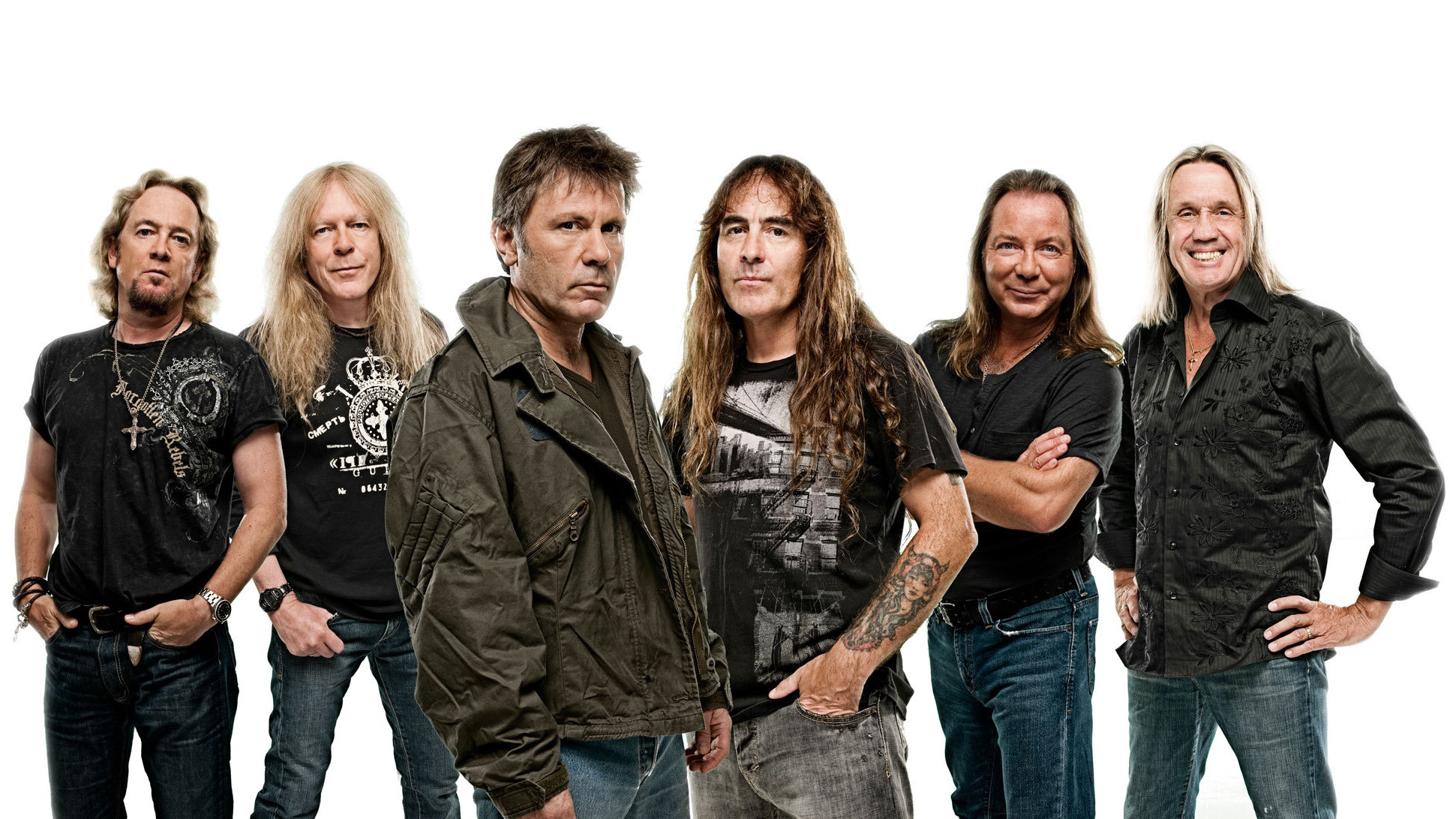
The subsequent lineup of Harris, Dickinson, Murray, Smith, Janick
Gers (who had joined in 1990) and Nicko McBrain has been stable
for over twenty-five years.
The modern era — Brave New World (2000),
Dance of Death (2003),
A Matter of Life and Death (2006),
The Final Frontier (2010),
The Book of Souls (2015) and Senjutsu (2021) —
has produced consistently ambitious and frequently excellent work,
with the three-guitarist lineup giving the arrangements a depth
and complexity unavailable to earlier configurations. The band
shows no sign of retiring.
Iron Maiden Songs: FAQ
What is Iron Maiden's best song?
Hallowed Be Thy Name is almost universally considered
Iron Maiden's finest song — a seven-minute masterpiece that
tracks a condemned man's final moments before execution, voted
consistently among the greatest heavy metal recordings of all
time. The Trooper is the most kinetically perfect;
Fear of the Dark has the greatest live identity.
What does Hallowed Be Thy Name mean?
Written from the perspective of a condemned man facing execution
— tracking his thoughts from the final morning through the walk
to the gallows, philosophical questioning of death and
afterlife, to a kind of acceptance. Steve Harris was influenced
by Dylan Thomas's "Do Not Go Gentle into That Good Night" and by
the specific horror of capital punishment. The title inverts the
Lord's Prayer — not a rejection of God but a desperate
engagement with what anything means in the face of death.
What does The Number of the Beast mean?
Inspired by a nightmare Steve Harris had after watching
Damien: Omen II. A Gothic horror narrative about a
horrifying vision of a Satanic ritual, with the narrator as an
unwilling witness who ultimately rejects it. Not Satanic in
intent. The record-burning protests that greeted its release
were based on a fundamental misreading of the song's nature.
What does Fear of the Dark mean?
About the primal, irrational fear of darkness that many people
experience even in adulthood — the sensation of something
malevolent present in the dark that the conscious mind knows
isn't there but deeper brain responses insist upon. Bruce
Dickinson has described it as his most personally direct Iron
Maiden lyric — a genuine account of his own experience of this
fear.
What does Run to the Hills mean?
Alternates between the perspective of a Native American
experiencing the violence of European colonialism and the
colonists' own viewpoint. Steve Harris wrote it as a commentary
on the historical experience of Indigenous Americans. The two
perspectives are not morally equivalent — the song makes clear
who the victim is. Its galloping rhythm and "Run to the Hills"
chorus have made it one of the most celebrated heavy metal
singalongs in history.
Who is Bruce Dickinson?
Bruce Dickinson (born 1958, Worksop, Nottinghamshire) is Iron
Maiden's vocalist — known as "the Air Raid Siren" for his
four-octave tenor range. Also a commercial airline pilot (Boeing
757/747 qualified), novelist, screenwriter, beer brewer and
competitive fencer. Left Maiden in 1993, returned in 1999.
Diagnosed with tongue cancer in 2015, successfully treated and
returned to touring in 2016.
What is the best Iron Maiden album to start with?
The Number of the Beast (1982) is the best starting
album — it contains Hallowed Be Thy Name,
Run to the Hills and
The Number of the Beast and is the first full album
with Bruce Dickinson. Piece of Mind (1983) is the
essential second step. Powerslave (1984) is the
artistic peak.
What does The Trooper mean?
Narrated by a British cavalry soldier during the Charge of the
Light Brigade at Balaclava (1854) — the catastrophic charge
ordered directly into Russian artillery due to a command
miscommunication. The soldier knows the charge is suicidal but
follows orders. The galloping drum and bass pattern is literally
the sound of horses running toward cannon fire. Based on
Tennyson's famous poem about the same event.
Is Iron Maiden still active?
Yes. Iron Maiden released Senjutsu in 2021 and continue
to tour internationally on an ambitious scale. The current
lineup of Bruce Dickinson, Steve Harris, Dave Murray, Adrian
Smith, Janick Gers and Nicko McBrain has been stable since 1999.
Where are Iron Maiden from?
Iron Maiden formed in Leyton, East London in 1975 — founded by
Steve Harris, who is from Leytonstone. They developed on the
London pub rock circuit in the late 1970s and were a central
part of the New Wave of British Heavy Metal movement. They are
one of the most internationally successful British rock exports
of all time.
Explore More Metal Guides