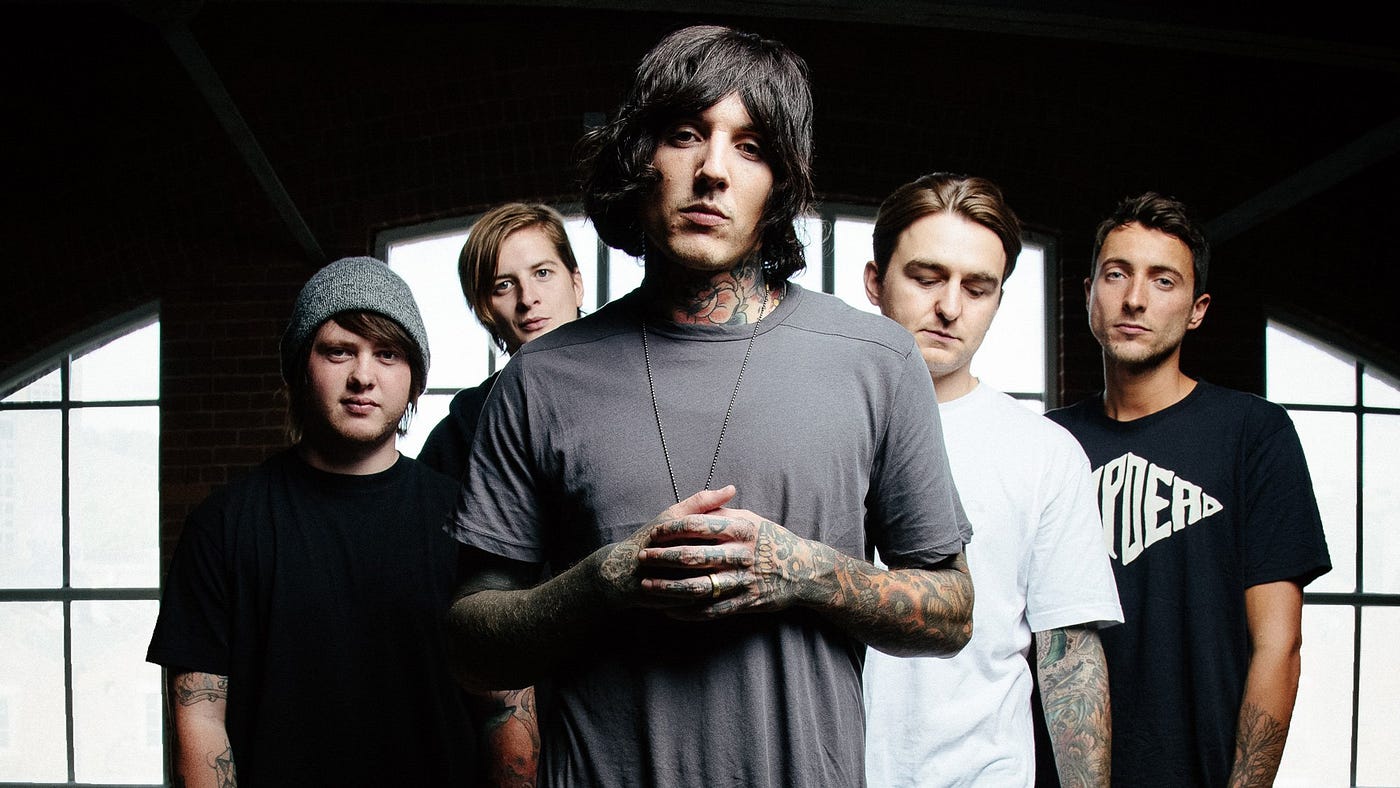
What Makes a Great Bring Me the
Horizon Song?
A great Bring Me the Horizon song does something that very few
bands of their origin can claim: it makes the emotional content
feel genuinely serious without losing the physical impact that
drew listeners to heavy music in the first place. The best BMTH
songs — Can You Feel My Heart, Sleepwalking,
Drown — address mental illness, addiction and the fear of
losing yourself with a directness that most mainstream rock
avoids, and they do it inside arrangements that hit as hard as any
metal.
Bring Me the Horizon formed in Sheffield, England in 2004. Oli
Sykes, Lee Malia, Matt Kean, Matt Nicholls and (from 2012) Jordan
Fish started as a deathcore band with virtually no melody — their
debut, Count Your Blessings (2006), is among the most
extreme things a band with subsequent mainstream success has ever
released. The evolution that followed — through
Suicide Season, There Is a Hell, the fully
realised Sempiternal, the pop-rock pivot of
That's the Spirit and the experimental
POST HUMAN series — is one of the most dramatic creative
reinventions in rock history.
This ranking focuses on the period from
Sempiternal onwards for the majority of its entries,
because that is where the songwriting quality is highest and where
the emotional content is most fully integrated with the musical
execution. The two pre-Sempiternal entries (Crooked Young
and Sleepwalking) are there because they are genuinely
exceptional and because omitting the transition period entirely
would misrepresent the full picture.
Top 10 Bring Me the Horizon Songs
Ranked
Can You Feel My Heart is BMTH's definitive song — the
track that most completely demonstrates what the band can do
and where every element (the piano introduction, the lyric,
the dynamic contrast, the chorus weight) functions at its
highest level simultaneously. The opening figure — a piano
line with a slightly unnerving melodic shape — establishes an
atmosphere of fragile menace before the song builds through
its verse into the chorus, where the weight of the arrangement
lands with a force proportional to the restraint that preceded
it.
The dynamic contrast is the key compositional decision: by
starting quiet and building patient, the song ensures that the
heavy sections carry emotional weight rather than simply
physical impact. This is the technique that distinguishes
great metalcore songwriting from competent metalcore
songwriting, and Can You Feel My Heart executes it
with more precision than any other BMTH track. Oli Sykes's
vocal moves between the vulnerable melodic passages of the
verse and the aggressive delivery of the chorus without the
transition feeling like a genre exercise.
The lyric's subject — mental illness and the fear of losing
yourself to it, the desperate question of whether the person
you love can still reach the part of you that is still present
— connects with listeners who recognise that specific
experience. Sykes has described it as the most personally
meaningful song he has written, and the specificity of what it
describes gives it a credibility that more general treatments
of mental health in heavy music often lack.
Song Meaning
Can You Feel My Heart is about mental illness and
addiction — specifically the fear of losing control of your
own mind and the effect of that on the people you love. The
recurring question "can you feel my heart?" is directed both
at someone the narrator loves and at himself — an attempt to
confirm that he is still present, still connected, still
reachable. Oli Sykes has described writing it from his
experience of drug addiction and the dissociation it
produced: the sense of watching yourself from outside, of
not being certain whether the person inside the body is the
real you or some diminished version. The lyric captures that
specific terror with unusual precision.
Why #1: the most complete BMTH song — where
the dynamic contrast, the emotional content and the production
all operate at their highest level simultaneously.
Throne is the most immediately powerful and broadly
accessible BMTH track — the song that brought the band to
their widest mainstream rock audience and that functions as
both a personal defiance anthem and a collective declaration
of resilience. Where Can You Feel My Heart requires
the listener to engage with specific emotional vulnerability,
Throne meets listeners where they are and provides
the energy to continue.
The production on That's the Spirit was a deliberate
shift toward mainstream rock — less extreme, more focused on
hooks, more radio-accessible than anything in the previous
catalogue. Throne is the track that most completely
vindicates that shift: the chorus is enormous, the pre-chorus
builds effectively, and the overall feeling is of genuine
conviction rather than commercial calculation. It demonstrated
that the band could write arena rock without losing the
intensity that made the earlier material matter.
Song Meaning
Throne is a defiance anthem — a response to years
of being written off, criticised and dismissed. Oli Sykes
has described it as addressing everyone who predicted the
band would not survive their commercial evolution, every
critic who dismissed them as a phase, every person who tried
to make them feel their success was illegitimate. The
central image of building a throne from the wreckage of
others' low expectations is aggressive without being bitter
— it is a statement of having survived rather than a
celebration of revenge. The "I'll be the thorn in your side"
repetition is both a threat and a statement of permanence: I
am still here, and I will remain.
Why #2: the most broadly powerful BMTH track
— defiance and arena scale in the same song, executed with
genuine conviction rather than commercial compromise.
Sleepwalking is the most atmospheric and texturally
accomplished track on Sempiternal — a song that uses
the titular metaphor to describe the dissociated quality of
depression with an accuracy and vividness that the more direct
lyrical approaches on the same album do not always achieve.
The arrangement creates a dreamlike quality in the verse
sections before the heavier passages arrive, and the contrast
between those two states mirrors the subject matter: the
disconnected surface and the turbulent interior.
Jordan Fish's keyboard and electronic contributions are most
prominent and most effective here — the atmospheric production
choices that distinguish Sempiternal from the
previous albums are on fullest display in
Sleepwalking, and the way the electronic elements
coexist with the heavy guitar work without either dominating
the other was the sonic achievement that made the album's
crossover impact possible. It is the track that most directly
demonstrates what the band could do once Fish joined and the
electronic elements became central rather than incidental.
Song Meaning
Sleepwalking uses the sleepwalking metaphor for the
numbing effect of severe depression — the experience of
going through the motions of daily life without genuine
presence or engagement. The body shows up, the person
functions at a surface level, but the internal experience is
one of complete disconnection. Oli Sykes has spoken about
writing from personal experience of this dissociated state
during the period of drug addiction and mental illness that
preceded and shaped the Sempiternal recording period. The
song is about surviving in the most minimal possible sense:
still here, still moving, but not really awake.
Why #3: the most atmospherically accomplished
Sempiternal track and the one where Jordan Fish's electronic
contributions are most completely integrated into the heavy
material.
Shadow Moses is the most immediately aggressive and
physically intense track on Sempiternal — the song
where the band's metalcore foundation is most directly and
unapologetically present after the melodic and atmospheric
experimentation of the rest of the album. The riff is one of
the finest in the BMTH catalogue, the breakdown is among the
heaviest the band ever recorded, and the lyric's defiance
("can you tell from the look in our eyes / we're going
nowhere") has a collective energy that the more introspective
surrounding material deliberately withholds.
The Metal Gear Solid reference in the title — Shadow Moses
being the location of the game's climactic events — gave the
song a specific cultural attachment for a significant portion
of the fanbase that deepened their connection to it, while the
song itself works entirely without that context. It has been a
live staple since its release and consistently generates the
most physical crowd response at BMTH shows.
Why #4: the heaviest and most physically
immediate Sempiternal track — the song that shows the
metalcore foundation survived the electronic and atmospheric
evolution intact.
Drown was released as a standalone single between the
Sempiternal and That's the Spirit albums,
and its transitional position gives it a clarity about where
the band was heading that the surrounding albums occasionally
obscure. The song is quieter and more melodically restrained
than most of the Sempiternal material while being
more emotionally direct than most of
That's the Spirit — it sits in a middle territory
that the band were passing through and that they captured
perfectly in a single track.
The water metaphor — depression as drowning, the narrator
underwater and unable to reach or be reached by the people
above them — is immediate and effective, and Sykes's vocal
performance in the verses has a vulnerability that the more
aggressive surrounding material does not always permit. It
became one of the band's most streamed and most shared songs,
reaching audiences well outside the heavy rock world.
Song Meaning
Drown is about depression and the specific feeling
of being overwhelmed by it — the experience of sinking under
emotional weight that you cannot control, while the people
around you remain on the surface and cannot understand or
reach you. The water metaphor is simple and effective: the
narrator is underwater, the rest of the world is not, and
the gap between those two states is both physical and
psychological. Oli Sykes has spoken about the song's
connection to his own experience and its intention to reach
listeners who recognise the same experience.
Why #5: the most perfectly positioned BMTH
song — capturing the exact transition point between the heavy
and the accessible, and doing both simultaneously better than
almost anything else in the catalogue.
Medicine is the most emotionally vulnerable and
melodically open track on That's the Spirit — the
song where the pop-rock direction the album pursues is most
clearly in service of genuine emotional content rather than
commercial calculation. The pharmaceutical metaphor (a
relationship as a medicine, the narrator as both dependent and
poisoned by it) is handled with enough ambivalence that the
song avoids the self-pity that weaker treatments of the same
subject produce.
It demonstrates that BMTH's evolution toward a more accessible
sound was motivated by the desire to reach more people with
genuine emotional content rather than by the desire to chart.
The most important BMTH songs are the ones where the emotional
content and the production approach are both working at full
capacity; Medicine is the clearest
That's the Spirit example of that alignment.
Why #6: the most emotionally precise That's
the Spirit track — the accessible production in service of
genuine vulnerability rather than commercial surface.
Avalanche is the most compositionally adventurous
track on That's the Spirit and the one that sits most
comfortably alongside the Sempiternal material in
terms of emotional ambition. The song addresses
self-destructive behaviour — the specific way that some people
damage themselves and others as an expression of pain they
cannot articulate more directly — with a candour that the
album's more accessible tracks occasionally sacrifice for the
sake of the hook.
The dynamic of the song — the controlled verses and the
explosive chorus — mirrors the subject matter of accumulated
damage suddenly releasing. It is also one of the best BMTH
vocal performances: Sykes manages the transition between the
quiet and heavy sections with a control and emotional
continuity that the more extreme material from earlier in the
catalogue does not require.
Why #7: the most compositionally ambitious
That's the Spirit track — the song that sits closest to the
Sempiternal era's emotional depth while belonging to the more
accessible album.
True Friends is the most direct and least emotionally
complex track in this ranking — a song about betrayal and the
specific anger of discovering that people you trusted have
been acting against you — and it earns its place because
directness at this level of execution is its own form of
achievement. The verse riff has a groove and momentum that the
more atmospheric surrounding material on
That's the Spirit deliberately withholds, and the
chorus's simple repetition of "true friends stab you in the
front" lands with a force that more elaborate lyrical
treatments of the same subject often fail to achieve.
It is a live favourite because its energy and its directness
translate immediately to large crowds without requiring prior
familiarity with the emotional territory it maps. As an
introduction to the BMTH sound for listeners who have not yet
encountered the more complex material, it is the most
immediately effective track in the catalogue.
Why #8: the most direct and most immediately
effective BMTH track — where the simplicity of the emotional
content is a strength rather than a limitation.
Crooked Young is the essential early-era BMTH track
and the one that most clearly points toward the direction
Sempiternal would eventually pursue. On an album that
is mostly aggressive metalcore, it is a slower, more melodic
piece with an atmospheric quality that distinguishes it from
the surrounding material — the first evidence of the band's
ability to do something more considered than the raw energy of
the debut.
The lyric's portrait of youth as something simultaneously
vital and destructive — the "crooked young" as people who are
simultaneously full of life and full of damage — is the first
fully developed piece of BMTH character writing, and the
restraint of the arrangement gives it a resonance that the
heavier material on the same album cannot achieve. It is the
seed of everything the band would become.
Why #9: the essential early BMTH track — the
first clear evidence of the melodic and atmospheric ambition
that would define Sempiternal five years later.
Doomed closes this ranking as the most emotionally
desolate track on That's the Spirit — a song that
sets aside the album's more energetic material in favour of
something quieter, more piano-driven and more genuinely
vulnerable. The subject is the specific exhaustion of
maintaining the performance of normality when internally
nothing is functioning — the feeling of being beyond help and
beyond the capacity to ask for it.
It is the That's the Spirit track that most directly
continues the emotional territory of
Can You Feel My Heart and Sleepwalking from
the previous album, and its presence here reflects the honest
assessment that the most important BMTH songs are the ones
that address the most difficult emotional content with the
least theatrical distance. Doomed has none of the
theatrical distance — it is the band at their most exposed,
and the exposure is the point.
Why #10: the most emotionally desolate That's
the Spirit track — where the album's accessible production
gives way to something undefended and genuinely difficult.
Best Bring Me the Horizon Songs for
Beginners
New to BMTH? These six tracks introduce the different eras and
emotional registers of the catalogue without requiring prior
knowledge of the heavier early material.
ThroneStart here — the most immediately accessible and broadly
powerful BMTH track. Defiance at arena scale.
DrownThe transitional masterpiece — melodic, emotionally direct,
the clearest bridge between the heavy and the
accessible.
True FriendsThe most direct and energetic track — the best live-energy
introduction to the BMTH sound.
Can You Feel My HeartOnce you know the lighter material — this is where you
discover how deep the catalogue goes.
SleepwalkingThe Sempiternal album's atmospheric peak — where the
electronic and heavy elements combine most completely.
Shadow MosesThe heaviest essential BMTH track — for when you want to go
deeper into the metalcore foundation.
Oli Sykes: Vocalist and Creative
Director
Oliver Scott Sykes was born on 20 November 1986 in Hexham,
Northumberland, and grew up partly in Sheffield. He co-founded
Bring Me the Horizon in 2004 as a teenager and has been the band's
primary creative force and public face across their entire
evolution — from the screamed deathcore vocals of the debut
through to the melodic, emotionally direct singing of the recent
material.
His vocal evolution mirrors the band's sonic evolution: the
screamed delivery of Count Your Blessings gave way
progressively to the mixed clean/aggressive approach of
Suicide Season and There Is a Hell, the
primarily clean but emotionally intense performance on
Sempiternal, and the more pop-influenced delivery of
That's the Spirit and beyond. Each shift required a
different technical capability, and the consistency of his
emotional presence across all of them is what makes the evolution
feel coherent rather than simply commercial.
Sykes has spoken publicly and consistently about his experience
with drug addiction during the period leading up to and through
the Sempiternal recording — describing ketamine
dependency, the dissociation it produced, and the process of
recovery that shaped the album's emotional content. His
willingness to discuss mental health, addiction and personal
struggle in specific rather than general terms has made him a
significant figure for fans who recognise their own experiences in
the music.
He also founded and runs Drop Dead, a Sheffield-based clothing
brand, which has become one of the more commercially successful
band-adjacent creative projects in British rock. The aesthetic of
Drop Dead — dark, graphic, horror-influenced — is continuous with
the band's visual identity and reflects Sykes's involvement in
every dimension of what BMTH presents to the world.
The BMTH Evolution: From Deathcore to
Everywhere
Few bands in rock history have made a more dramatic or more
successful creative evolution than Bring Me the Horizon. The band
that released Count Your Blessings in 2006 — a deathcore
album with virtually no melody, almost entirely screamed vocals
and a sound that appealed to a very specific and very small
subculture — is formally the same band that headlined Reading and
Leeds in 2018 and had a UK number one album with amo in
2019. The distance between those two points is not a matter of
degree but of kind.
The evolution happened incrementally but consistently.
Suicide Season (2008) introduced melody into a primarily
aggressive framework.
There Is a Hell, Believe Me I've Seen It, There Is a Heaven,
Let's Keep It a Secret
(2010) brought orchestral elements and a more ambitious
compositional approach. Sempiternal (2013) — the creative
peak, in this ranking's assessment — introduced Jordan Fish's
keyboards and electronics and produced the most fully integrated
combination of heavy and melodic elements the band has achieved.
That's the Spirit (2015) moved into mainstream rock
territory. amo (2019) incorporated pop, R&B and
electronic music more explicitly. The POST HUMAN series
(2020 onwards) has pushed further into genre-blurring territory
still.
That evolution has been commercially successful and creatively
motivated — the band have not changed direction simply to chase
audiences but to pursue wherever the music took them, which is the
more interesting and more sustainable version of creative growth.
The fanbase that followed from Count Your Blessings to
That's the Spirit is genuinely one of the most loyal in
rock, and the loyalty is earned by the consistency of the
emotional content beneath the changing sound.
Best Bring Me the Horizon Albums to
Hear Next
2013
Sempiternal
The best starting album for most new listeners and the most
fully realised BMTH record. Contains
Can You Feel My Heart, Sleepwalking,
Shadow Moses and True Friends. The album
where the heavy and the atmospheric most completely coexist,
and the one most consistently cited by fans as the creative
peak.
2015
That's the Spirit
The mainstream breakthrough and the best entry point for
listeners coming from a broader alternative rock background.
Contains Throne, Drown, Medicine,
Doomed and True Friends. More melodic and
more accessible than Sempiternal; equally committed
to emotional directness.
2010
There Is a Hell, Believe Me I've Seen It...
The transitional album and the first evidence of the
orchestral and atmospheric ambitions that would define
Sempiternal. Contains Crucify Me,
Anthem, It Never Ends and
Crooked Young. More heavy than what followed but
with enough melodic variety to serve as an entry point for
listeners who want to understand the evolution.
2008
Suicide Season
The second album and the first with significant melody.
Contains Suicide Season,
The Sadness Will Never End and
Crooked Young. An important transitional record for
understanding where the band came from and how quickly they
evolved after the debut.
2019
amo
The genre-blurring UK number one. Contains Mantra,
Medicine, Heavy and
Nihilist Blues. The most sonically diverse BMTH
album — not everything works, but the best tracks are among
the most adventurous in the catalogue. Best approached after
the core albums.
Honourable Mentions
BMTH have one of the richest catalogues in modern rock, and this
top 10 leaves out many essential tracks. Strong honourable
mentions include:
-
It Never Ends (There Is a Hell, 2010)
— the most melodically complete track on the third album and the
clearest pointer to the Sempiternal sound, three years before
that album existed
-
Crucify Me (There Is a Hell, 2010) —
the orchestral album opener, featuring Charlotte Sands, which
demonstrated that BMTH's ambitions extended to fully scored
arrangements
-
Antivist (Sempiternal, 2013) — the
most aggressively political BMTH track and a live favourite for
its energy and directness
-
And the Snakes Start to Sing
(Sempiternal, 2013) — the most emotionally restrained
and patient Sempiternal track, a quiet closing statement that
rewards close listening
-
Mantra (amo, 2019) — the most
immediately effective amo-era track and the best introduction to
the band's post-That's the Spirit direction
-
Ludens (standalone single, 2019) — the Death
Stranding game tie-in that became one of the most celebrated
BMTH singles, capturing a grandeur and cinematic scope that the
studio albums rarely sustain for a full track
-
Parasite Eve (POST HUMAN: Survival Horror, 2020) — the essential POST HUMAN track and the one that
sounds most directly continuous with the Sempiternal/That's the
Spirit material
Bring Me the Horizon Band History
Bring Me the Horizon formed in Sheffield, England in 2004, when
most members were in their mid-teens. The founding lineup — Oli
Sykes, Lee Malia, Matt Kean, Matt Nicholls and Curtis Ward —
released the debut album Count Your Blessings (2006) on
Visible Noise Records. The album was extreme deathcore — blast
beats, pig squeals, breakdowns — and divided even the metalcore
community, many of whom dismissed it as technically limited. Ward
left the band in 2007 and was not replaced.
Suicide Season (2008) and There Is a Hell (2010)
represented the incremental evolution toward melody and emotional
complexity that would eventually produce Sempiternal.
Both albums were produced by Fredrik Nordström and the improvement
in production quality across that sequence is dramatic. Jordan
Fish joined as keyboardist and producer for
Sempiternal (2013) — his contribution to the band's sound
was transformative, providing the electronic and atmospheric
elements that allowed the heavy and the melodic to coexist without
either compromising the other.
That's the Spirit (2015) was produced entirely by Fish
and marked the move to RCA Records. It was the band's most
commercially successful album at the time. amo (2019) was
a UK number one and their most genre-diverse record. The
POST HUMAN series — Survival Horror (2020) and
NeX GEn (2024) — represents the current creative
direction: collaborative, experimental and explicitly embracing
the broadest possible sonic palette. The band headline major
festivals internationally and remain one of the most significant
British rock acts of the 21st century.
Bring Me the Horizon Songs: FAQ
What is Bring Me the Horizon's best song?
Can You Feel My Heart is placed first in this ranking
as BMTH's most complete song — the piano introduction, the
dynamic contrast, the emotional content and the production all
operating at their highest level simultaneously.
Throne is the most broadly accessible and is the most
common answer from casual listeners. Sleepwalking and
Drown are most cited by dedicated fans.
What does Can You Feel My Heart mean?
About mental illness and addiction — specifically the fear of
losing yourself to them, and the effect on the people who love
you. The recurring question "can you feel my heart?" is directed
both at a loved one and at the narrator himself — an attempt to
confirm he is still present and connected. Oli Sykes has
described it as drawing from his experience of drug addiction
and the dissociation it produced.
What does Throne mean?
A defiance anthem — a response to years of being written off and
dismissed. Oli Sykes has described it as addressing everyone who
predicted the band would not survive their commercial evolution.
The central image of building a throne from the remains of
others' low expectations is a statement of having survived
rather than a celebration of revenge.
What does Drown mean?
About depression and the feeling of being overwhelmed by it —
the experience of sinking under emotional weight you cannot
control while the people around you remain on the surface and
cannot reach you. The water metaphor captures the isolation of
severe depression with directness and clarity.
Who is Oli Sykes?
Oli Sykes (Oliver Scott Sykes, born 1986, Hexham,
Northumberland) is BMTH's vocalist and primary creative
director. Known for his evolution from screamed deathcore to
melodic rock vocals, his public candour about addiction and
mental illness, and his founding of the Drop Dead clothing
brand. He has been the band's consistent creative centre across
their entire reinvention.
Where are Bring Me the Horizon from?
Bring Me the Horizon are from Sheffield, England. They formed in
2004 and developed within the Sheffield underground metal scene.
Sheffield's post-industrial identity — the same city that
produced Arctic Monkeys, Def Leppard and The Human League —
provided the environment in which the band formed.
What does BMTH stand for?
BMTH is the common abbreviation for Bring Me the Horizon, using
the first letter of each word. The band and their fanbase use it
regularly in merchandise, social media and general reference.
What is the best BMTH album to start with?
Sempiternal (2013) is the best starting album — the
most fully realised and emotionally coherent BMTH record,
containing Can You Feel My Heart,
Sleepwalking and Shadow Moses.
That's the Spirit (2015) is the right second step for
listeners who want the more accessible sound.
Is Bring Me the Horizon still active?
Yes. BMTH released POST HUMAN: NeX GEn in 2024 and
continue to headline major international festivals. They are one
of the most significant and most active British rock bands of
the 21st century.
What does Sleepwalking mean?
The sleepwalking metaphor describes the numbing dissociation of
severe depression — going through the motions of daily life
without genuine presence or engagement. The body functions and
the person shows up, but internally nobody is really home. Oli
Sykes has spoken about writing from personal experience of this
dissociated state during his period of drug addiction.